By henry · May 28, 2026
Newborn weight loss after birth: what's normal?
The short answer: most newborns lose 5 to 10% of their birth weight in the first few days, hit the lowest point around day 3 or 4, and regain it all by week two. It's not a sign you're doing anything wrong. Here's what the American Academy of Pediatrics, the WHO, and the NHS describe as the typical pattern, what changes by feeding type, and what's worth a call.
henry is a tracking tool, not a diagnostic device. The ranges in this article come from publicly available pediatric guidelines (AAP, WHO, NHS). Every baby is different. Always talk to your pediatrician with any concerns about your baby's feeding, output, or growth.
The 2-day visit
It's the two-day pediatrician visit. The nurse takes your baby off the scale, looks at the chart, and says "down 8 ounces from birth." Your stomach drops. You feed your baby fourteen times a day. How are they losing weight?
You're not alone, and you're not doing it wrong. Almost every newborn loses weight in the first week. The AAP describes 5 to 10% as the typical range, with the lowest weight usually around day 3 to 4 and full recovery by day 10 to 14. The 2-day visit catches the loss; the 2-week visit catches the regain.
What there is, though, is a curve.
What's typical (with AAP numbers)
The pattern over the first month, for healthy full-term babies:
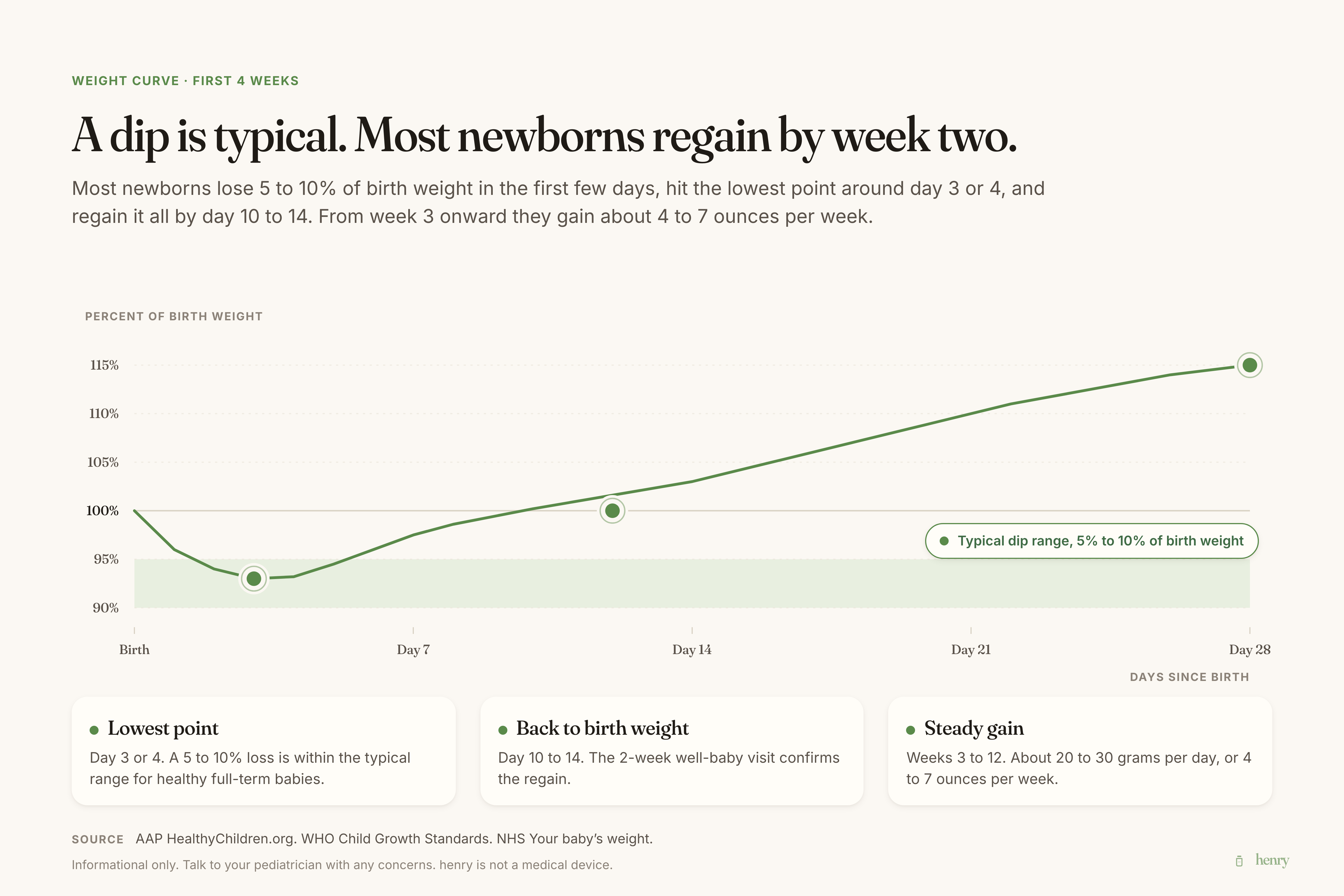
- Days 1 to 3. Weight drops. 5 to 10% loss is within the typical range. The nadir (lowest weight) is usually day 3 or 4.
- Days 4 to 10. Weight starts climbing as feeding and milk supply calibrate.
- Days 10 to 14. Most babies are back to birth weight. The 2-week well-baby visit confirms it.
- Weeks 3 to 12. Average gain of 20 to 30 grams per day, or about 4 to 7 ounces per week. About 1 to 2 pounds per month.
- Months 4 to 6. Slower gain, closer to 1 pound per month.
Sources: AAP HealthyChildren.org, How Often and How Much Should Your Baby Eat?; WHO Child Growth Standards; NHS Your baby's weight.
Why babies lose weight at all
Three things are happening in the first few days.
Fluid shifts. Babies are born with extra fluid from the womb. Some of it leaves in the first 48 hours as the body settles.
Meconium passage. The dark sticky first stools weigh a few ounces. They pass over the first 2 to 3 days. (More on this in How many wet and dirty diapers should a newborn have?.)
Feeding calibration. It takes a few days for milk supply and the baby's feeding rhythm to sync up. Breastfeeding mothers' milk transitions from colostrum (small volume, dense calories) to mature milk over days 3 to 5. Before that transition, intake is genuinely low. After it, intake catches up fast.
This is why the weight nadir lands around day 3 to 4 and recovery starts as the system settles.
How weight is measured (and when)
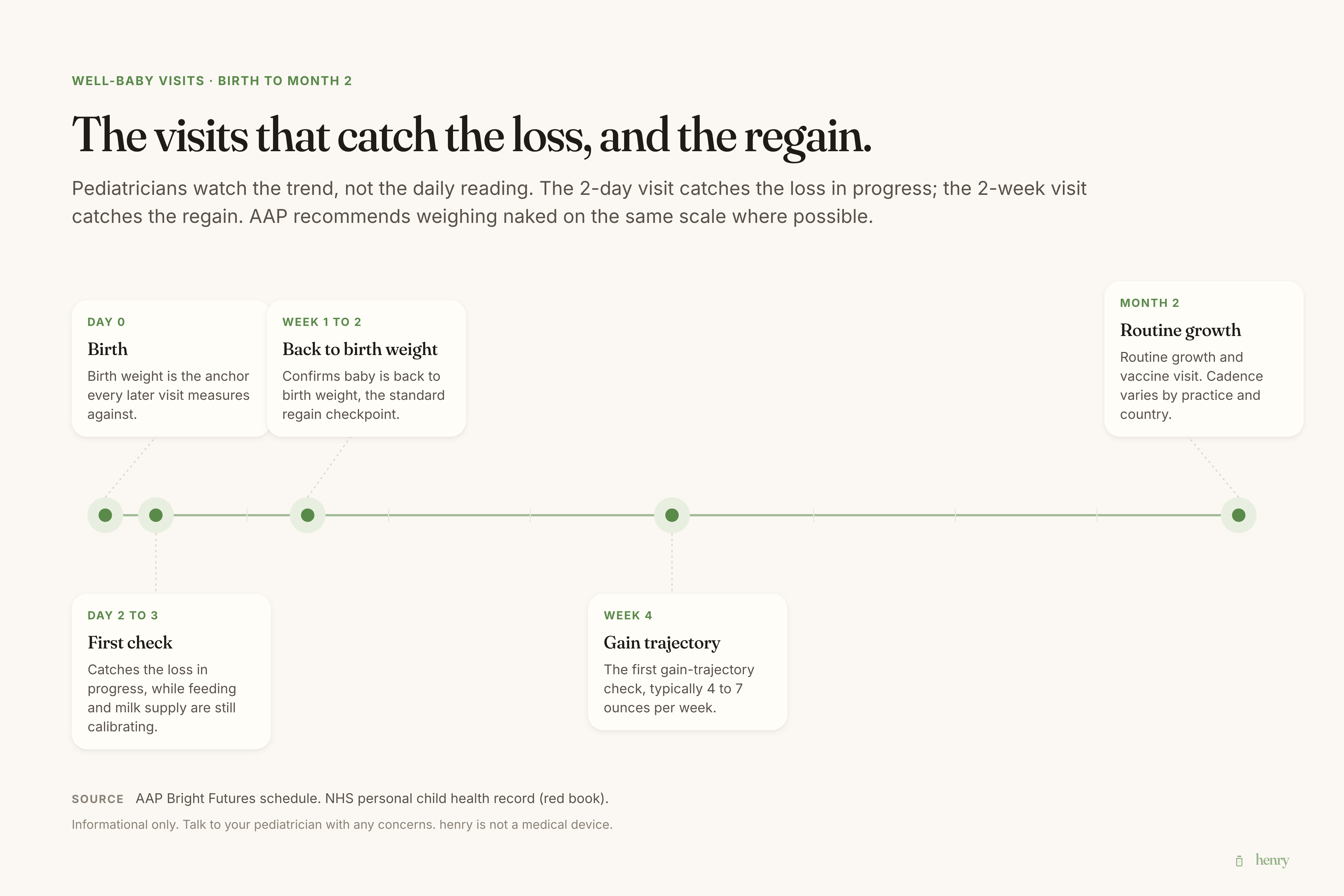
A standard well-baby visit schedule in the US looks like:
- Day 2 to 3. First check after discharge. Catches the loss-in-progress.
- Week 1 to 2. The "back to birth weight" checkpoint.
- Week 4. The first gain-trajectory check.
- Month 2, 4, 6. Routine growth + vaccine visits.
The schedule varies by practice and country (the NHS uses a slightly different cadence with a health visitor doing some checks at home). Whatever the schedule, two things matter to pediatricians.
The AAP recommends weighing naked, on the same scale where possible. A diaper, an onesie, or a different scale can shift the reading by 100 to 200 grams (3 to 7 oz), enough to make a healthy baby look like they aren't gaining.
Pediatricians watch the trend, not the daily reading. Newborn weight fluctuates with feeding, output, and time of day. The number on any single day matters less than the curve across visits.
By feeding type
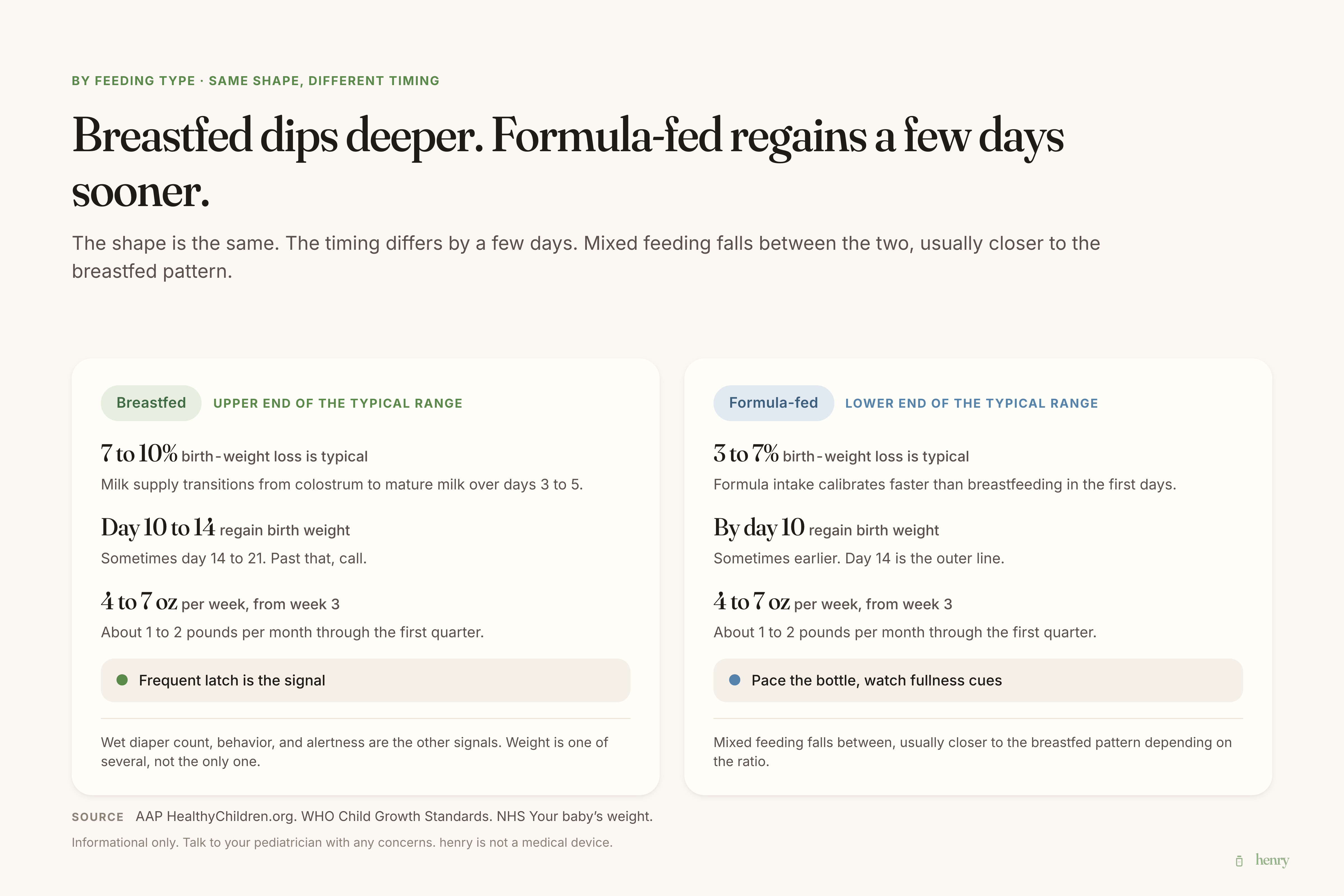
The shape is the same. The timing differs by a few days.
Breastfed. Loss often lands at the upper end of the typical range (7 to 10%), because the milk supply transition takes 2 to 5 days. Most breastfed babies regain birth weight by day 10 to 14, sometimes day 14 to 21. The AAP and La Leche League both treat day-14-to-21 regain as still within range, provided wet diapers, behavior, and the trend look right.
Formula-fed. Loss often lands at the lower end (3 to 7%), since formula intake calibrates faster than breastfeeding supply does. Most formula-fed babies regain birth weight by day 10, sometimes earlier.
Mixed. Falls somewhere in between, often closer to the breastfed pattern depending on the ratio.
The other signals from How much milk should a newborn eat? (wet diaper count, behavior between feeds, alertness) apply here too. Weight is one signal; those are the others.
When weight loss is a red flag
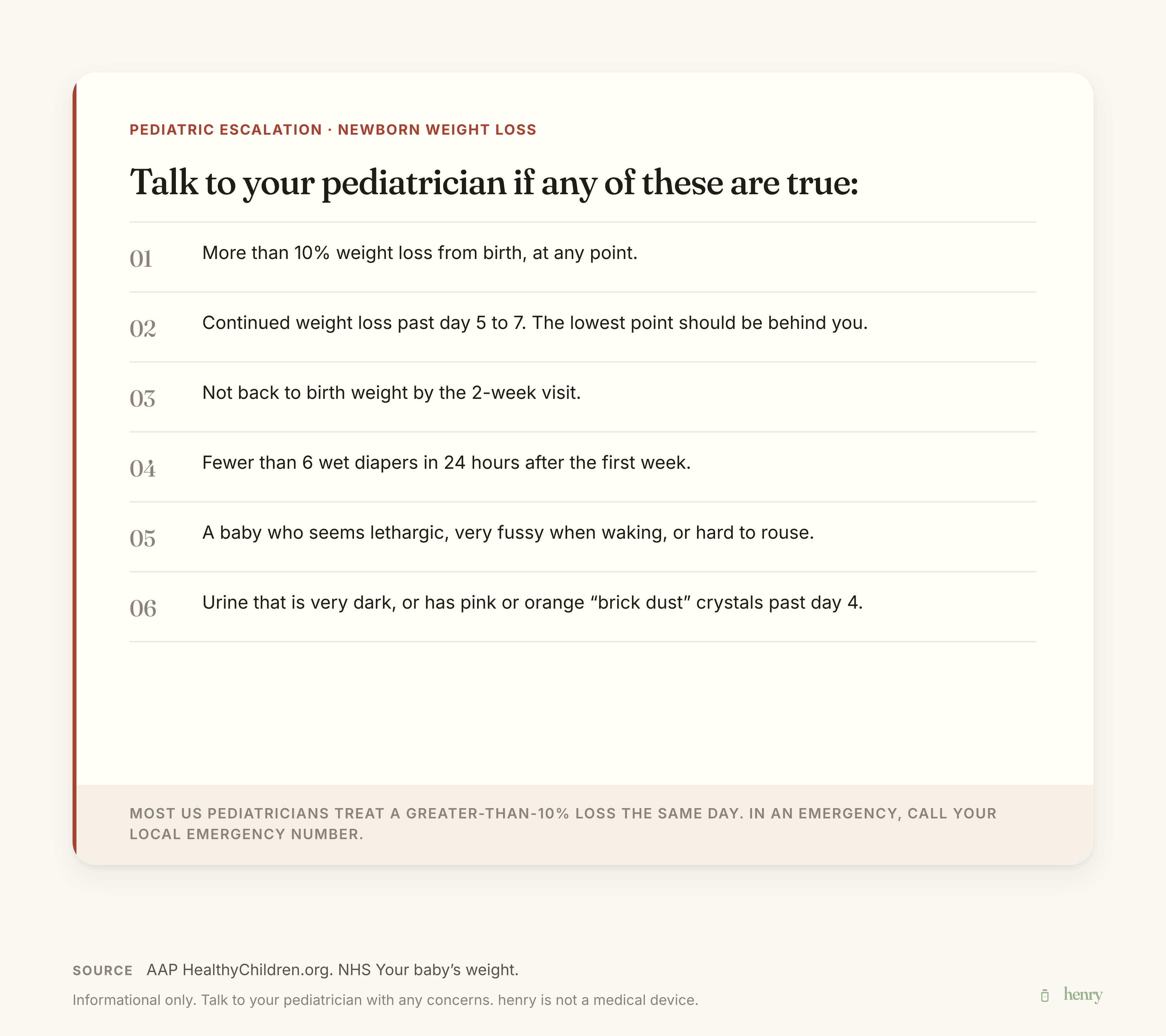
Talk to your pediatrician if any of the following are true:
- More than 10% weight loss from birth, at any point.
- Continued weight loss past day 5 to 7 (the nadir should be behind you).
- Not back to birth weight by the 2-week visit.
- Fewer than six wet diapers in 24 hours after the first week.
- A baby who seems lethargic, very fussy when waking, or hard to rouse.
- Urine that's very dark, or that has pink or orange "brick dust" crystals past day 4.
Most US pediatricians take a greater-than-10% loss seriously the same day. The NHS guidance is similar. Pediatricians expect calls from new parents. They would much rather take a false alarm than a delayed real one.
In an emergency, call your local emergency number.
How henry helps
henry logs each weigh-in with a single tap. The Trends overview plots your baby's weigh-ins over time next to the WHO benchmark ("most newborns regain birth weight by ~2 weeks, then ~150 to 210 g/week"). Tap in to see every weigh-in with its date and grams. When your pediatrician asks "what does the weight look like since discharge?" at the well-baby visit, you'll have the numbers without having to count back from notes.
henry is free on the App Store: henrytheapp.com.
henry shows you ranges from the American Academy of Pediatrics and the World Health Organization with their sources cited. We never tell you a number is "good" or "bad," only whether it falls inside or outside what's typical for a baby of that age. If you have any concern about your baby's feeding, growth, diapers, or health, talk to your pediatrician. In an emergency, call your local emergency number. henry is not a medical device and does not provide medical advice, a diagnosis, or a treatment plan.