By henry · May 25, 2026
How much milk should a newborn eat?
The short answer: less than you think, more often than you expect, and within a range that's wider than any single number can capture. Here's what the American Academy of Pediatrics and the WHO say about feeding amounts in the first months, and why "how much" matters less than "how do you know your baby is fed."
henry is a tracking tool, not a diagnostic device. The ranges in this article come from publicly available pediatric guidelines (AAP, WHO). Every baby is different. Always talk to your pediatrician with any concerns about your baby's feeding, output, or growth.
The 3am version
It's 3am. Your baby just finished a bottle and is still rooting. Or finished and fell asleep immediately. Or refused half of it. You scroll back through the day in your head, try to remember when the last feed was and how much went down. You can't remember. You guess. You feed again, maybe.
You're not alone, and you're not doing it wrong. Most newborns feed 8 to 12 times in 24 hours in the first few weeks, and the volume per feed varies by baby, by age, by time of day, and by whether they're breastfed, bottle-fed, or both. There is no number you're supposed to hit.
What there is, though, is a range.
By age (formula and bottle-fed, with AAP numbers)
The AAP's HealthyChildren guidance is the most-cited starting point. Numbers are expressed as ranges, and the AAP explicitly notes that babies regulate their own intake from day to day.
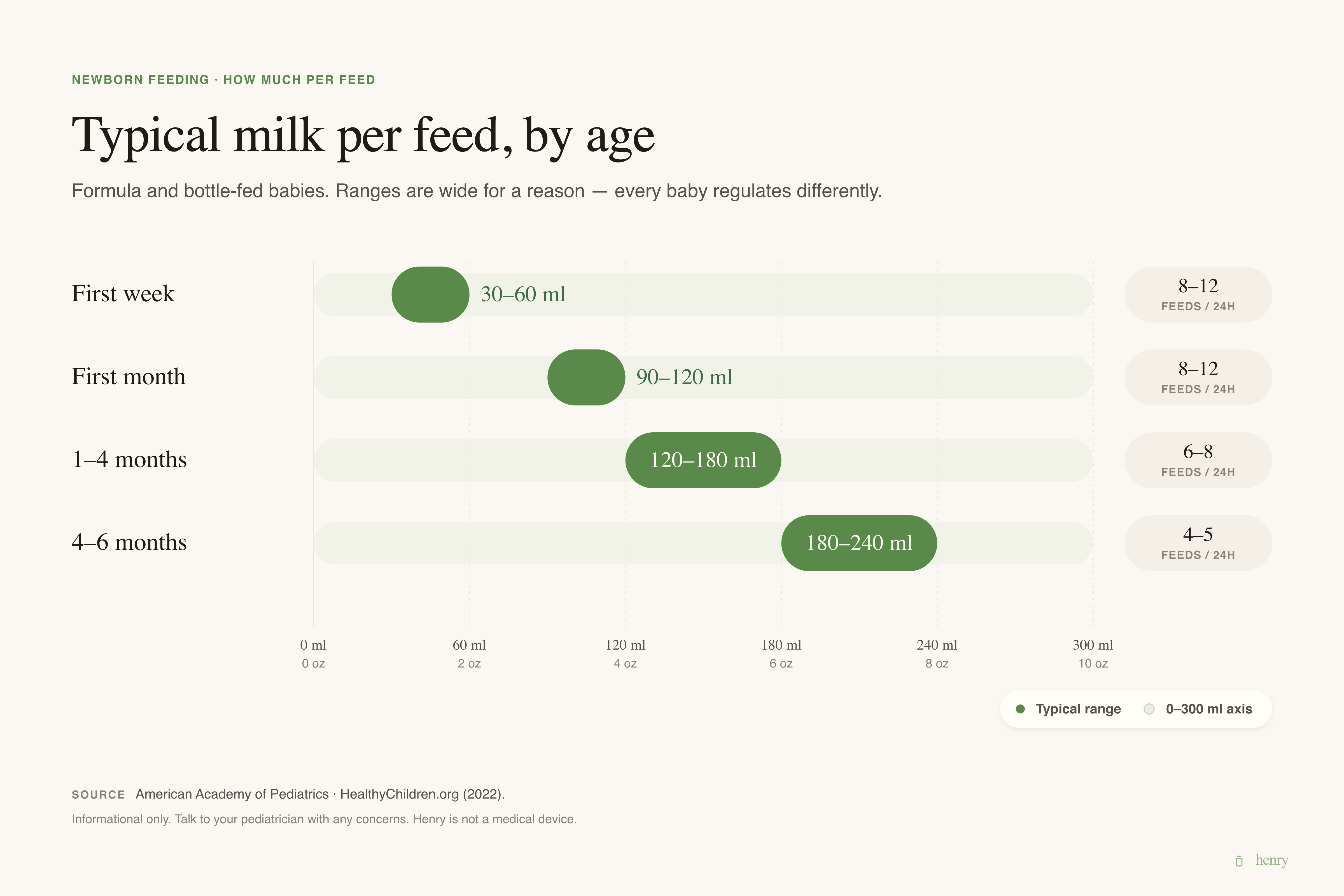
- First week: about 30 to 60 ml (1 to 2 oz) per feed.
- First month: gradually up to 90 to 120 ml (3 to 4 oz) per feed, roughly 8 to 12 feeds per 24 hours.
- One to four months: around 120 to 180 ml (4 to 6 oz) per feed, settling into 6 to 8 feeds per day.
- Four to six months: 180 to 240 ml (6 to 8 oz) per feed at 4 to 5 feedings per day.
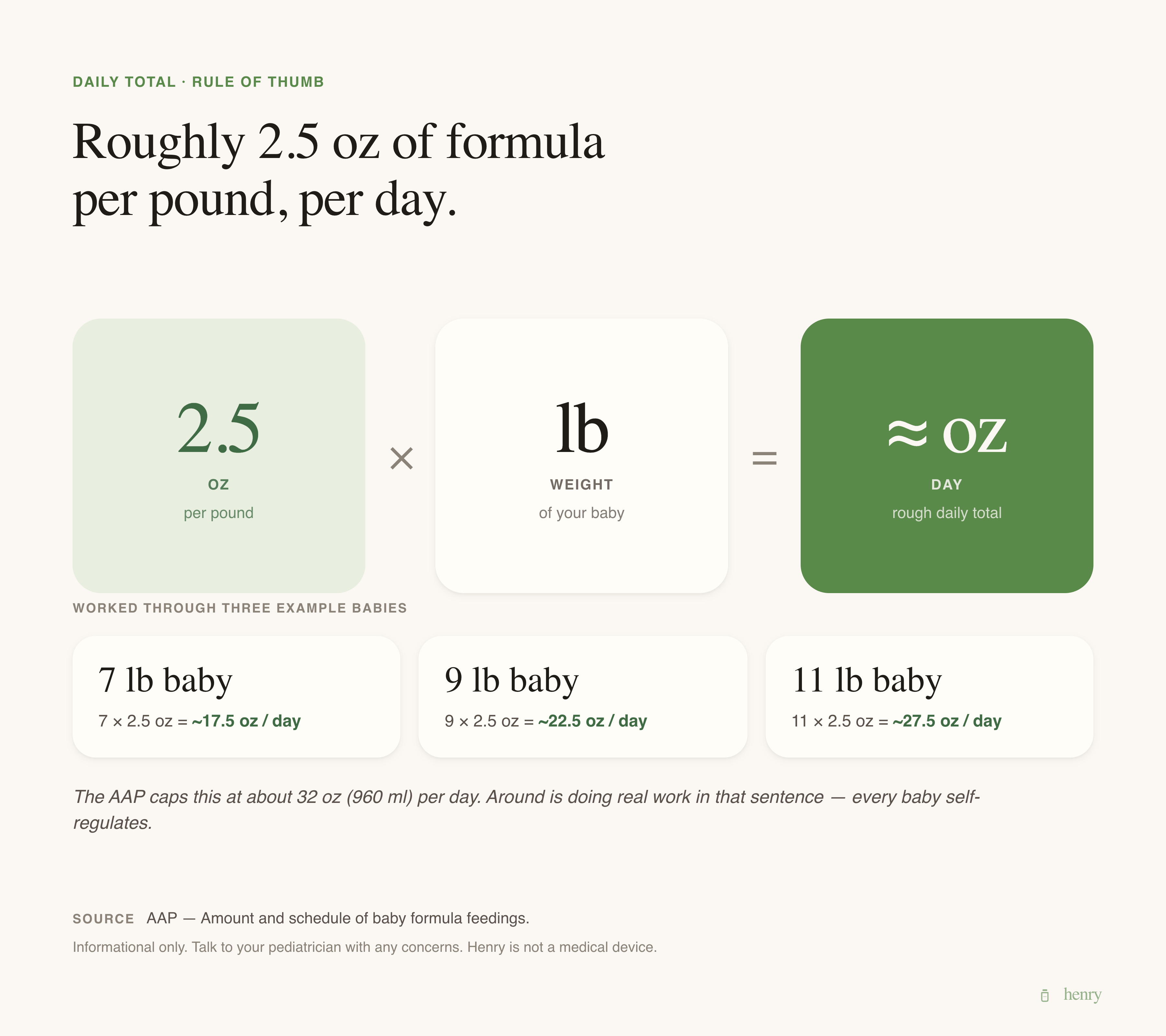
A useful rule of thumb from the AAP: a healthy, full-term baby will take roughly 2.5 oz (75 ml) of formula per pound of body weight per day, up to a maximum of about 32 oz (960 ml) per day. A 9-pound baby would land somewhere around 22 oz a day. Around is doing real work in that sentence.
Sources: AAP HealthyChildren.org, Amount and Schedule of Baby Formula Feedings and How Often and How Much Should Your Baby Eat?.
Breastfed babies
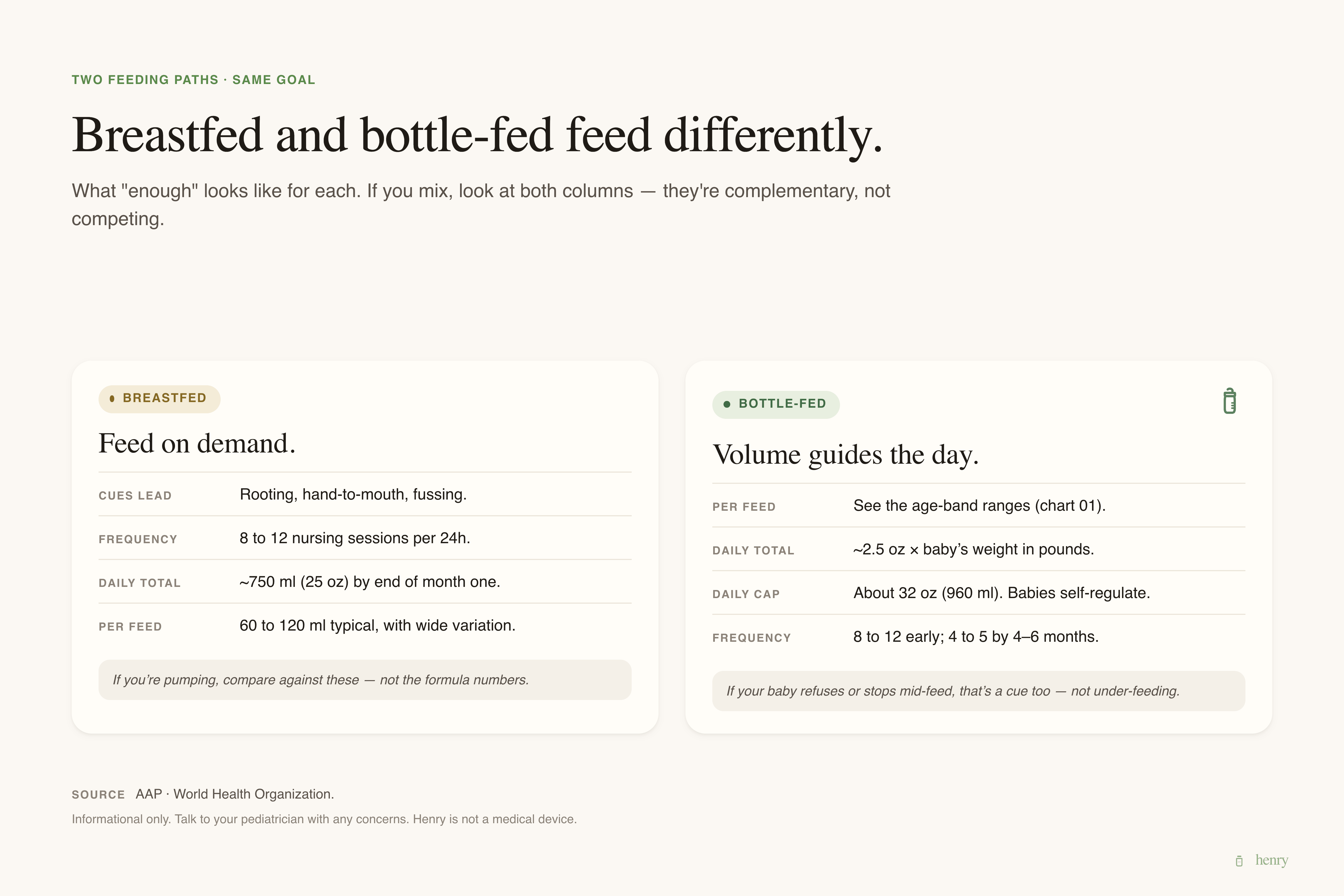
If you're breastfeeding, you can't measure volume directly, and that's fine. The WHO and AAP both recommend feeding on demand in the first weeks: when the baby shows hunger cues (rooting, hand-to-mouth, fussing), you feed. Most exclusively breastfed newborns will nurse 8 to 12 times in 24 hours.
For context, since people will ask: breastfed babies typically consume around 750 ml (25 oz) per day by the end of the first month, with wide variation between babies. Per feed, that often shakes out to around 60 to 120 ml depending on age, time of day, and how recently they last nursed. If you're pumping, those are the ranges to compare against, not the formula numbers above.
What matters more than the number
Counting ounces is the most visible thing a parent can do, which is why it's often the thing they stress about. The AAP, the NHS, and most pediatricians point to three signals that matter more.
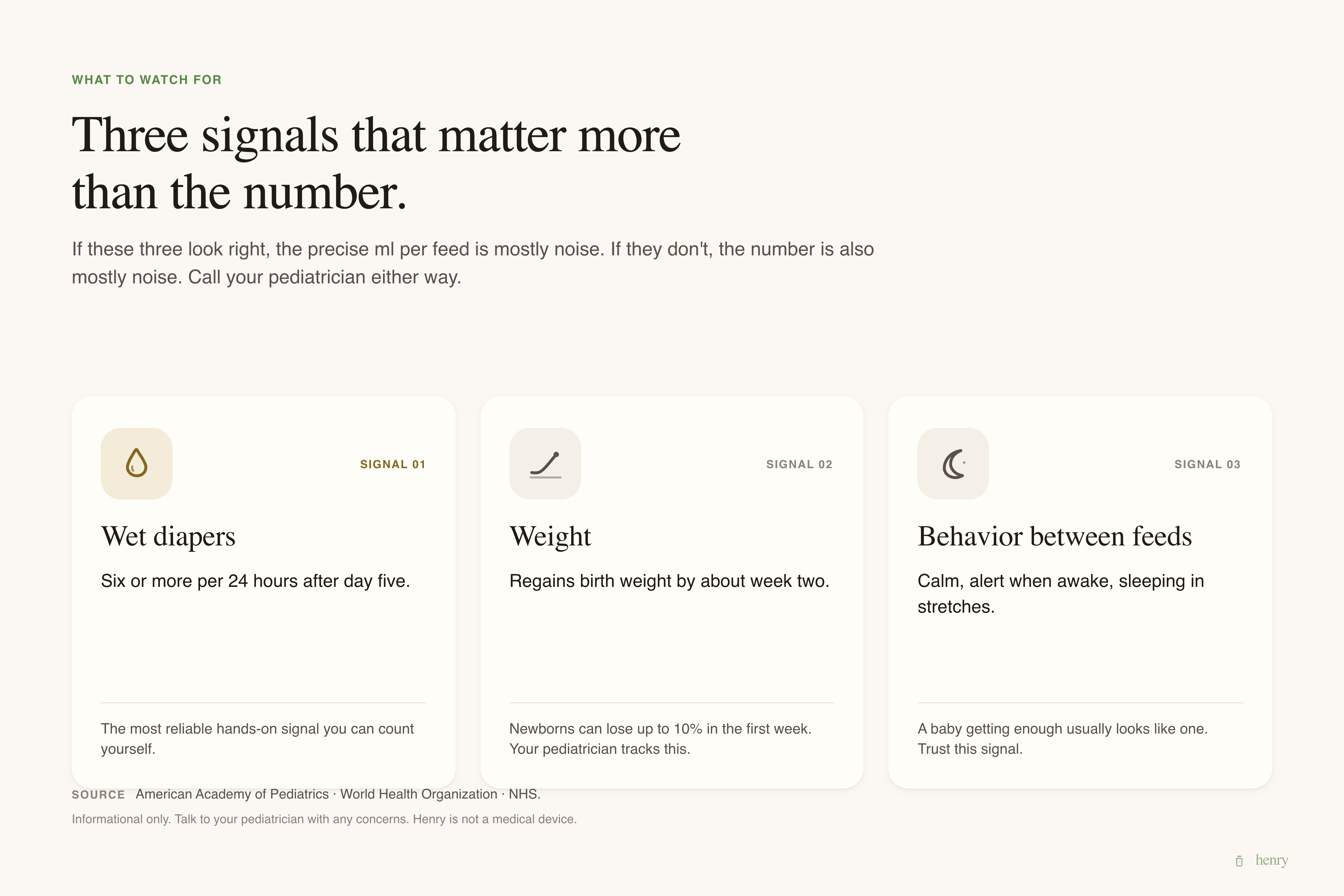
- Wet diapers. After day 5 or so, six or more wet diapers in 24 hours is a typical sign of adequate intake.
- Weight. Newborns typically lose up to 10% of birth weight in the first week and regain it by week two. Your pediatrician tracks this at well-baby visits.
- Behavior between feeds. A baby who is generally calm between feeds, alert when awake, and has stretches of contented sleep is usually a baby who's getting enough.
The AAP's framing is similar: if those three signals look right, the precise number per feed is mostly noise. If they don't, the number is also mostly noise. Call your pediatrician either way.
When to call your pediatrician
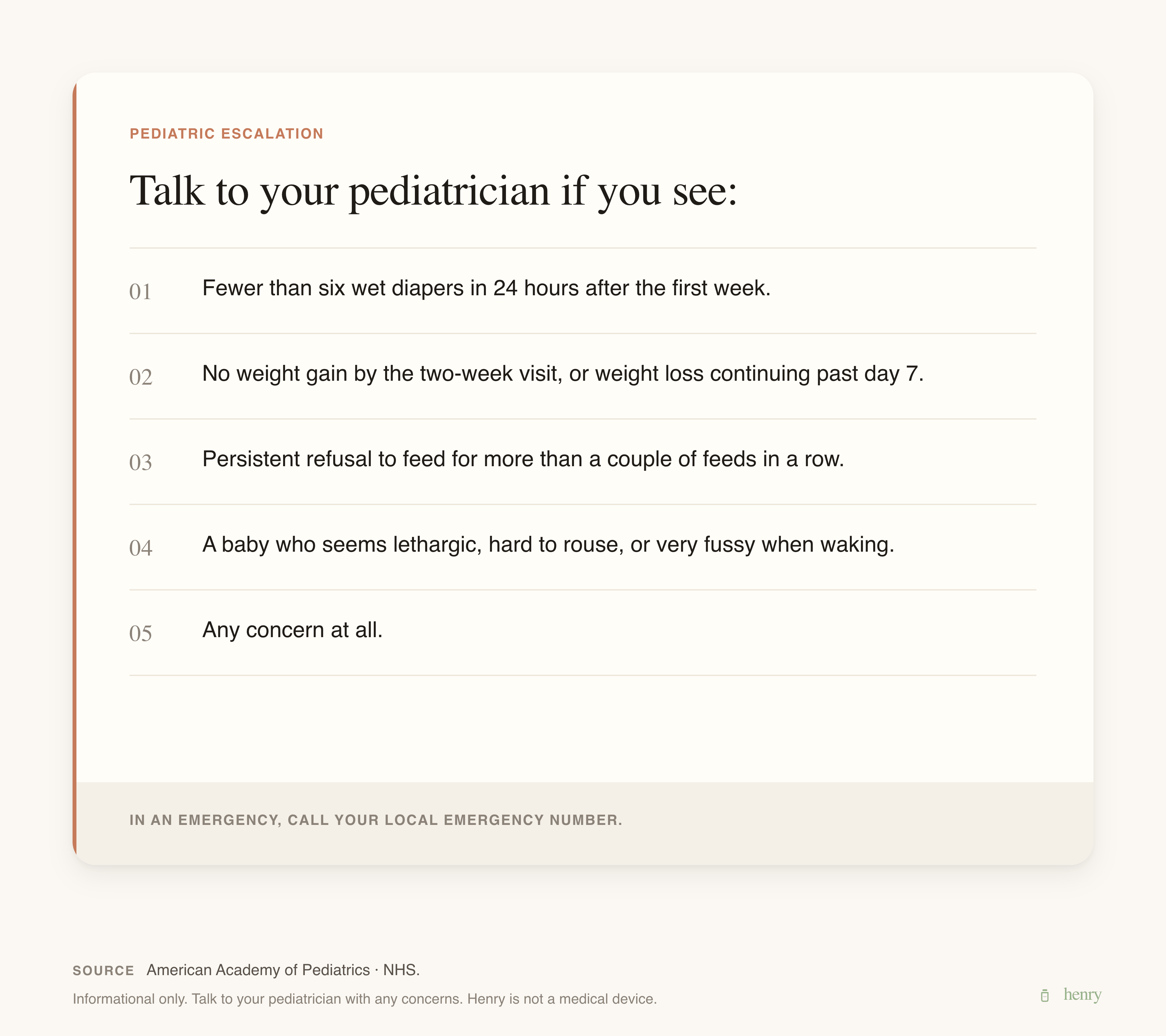
Talk to your pediatrician if any of the following are true:
- Fewer than six wet diapers in 24 hours after the first week.
- No weight gain by the two-week visit, or weight loss continuing past day 7.
- Persistent refusal to feed for more than a couple of feeds in a row.
- A baby who seems lethargic, hard to rouse, or very fussy when waking.
- Any concern at all. Pediatricians expect calls from new parents. They would much rather take a false alarm than a delayed real one.
In an emergency, call your local emergency number.
How henry helps
henry logs each feed with its volume and timestamp. Trends shows the daily total in ml or oz next to the AAP range ("roughly 150 to 200 ml/kg/day"), with the source cited. It never tells you a number is "good" or "bad," only whether it falls inside or outside what's typical for your baby's age. When your pediatrician asks "how much is she eating?" at the next visit, you'll have the answer without having to count.
henry is free on the App Store: henrytheapp.com.
henry shows you ranges from the American Academy of Pediatrics and the World Health Organization with their sources cited. We never tell you a number is "good" or "bad," only whether it falls inside or outside what's typical for a baby of that age. If you have any concern about your baby's feeding, growth, diapers, or health, talk to your pediatrician. In an emergency, call your local emergency number. henry is not a medical device and does not provide medical advice, a diagnosis, or a treatment plan.