By henry · May 26, 2026
How many wet and dirty diapers should a newborn have?
The short answer: not many in the first three days, then more than you'd expect by day five. After that the wet count stays steady, and the stool count gets wildly variable depending on how your baby is fed. Here's what the American Academy of Pediatrics, the NHS, and the WHO say to look for, day by day.
henry is a tracking tool, not a diagnostic device. The ranges in this article come from publicly available pediatric guidelines (AAP, NHS, WHO). Every baby is different. Always talk to your pediatrician with any concerns about your baby's feeding, output, or growth.
The 3am version
It's day three. You change a diaper that's barely damp, look down at the dark sticky thing in there, and Google "how many diapers should a newborn have." You get six different answers from six different sites, all confidently certain.
You're not alone, and you're not doing it wrong. The first week is a ramp. Day one: one wet diaper, one stool, both small. By day five: six or more wets, three or more stools. After that things settle, and what's "typical" depends on whether your baby is breastfed, formula-fed, or both.
What there is, though, is a pattern.
The first week, day by day
The rule of thumb most pediatricians use: wet-diaper count tends to match the day of life for the first five days, then settles at six or more per day. Stool count ramps in parallel.
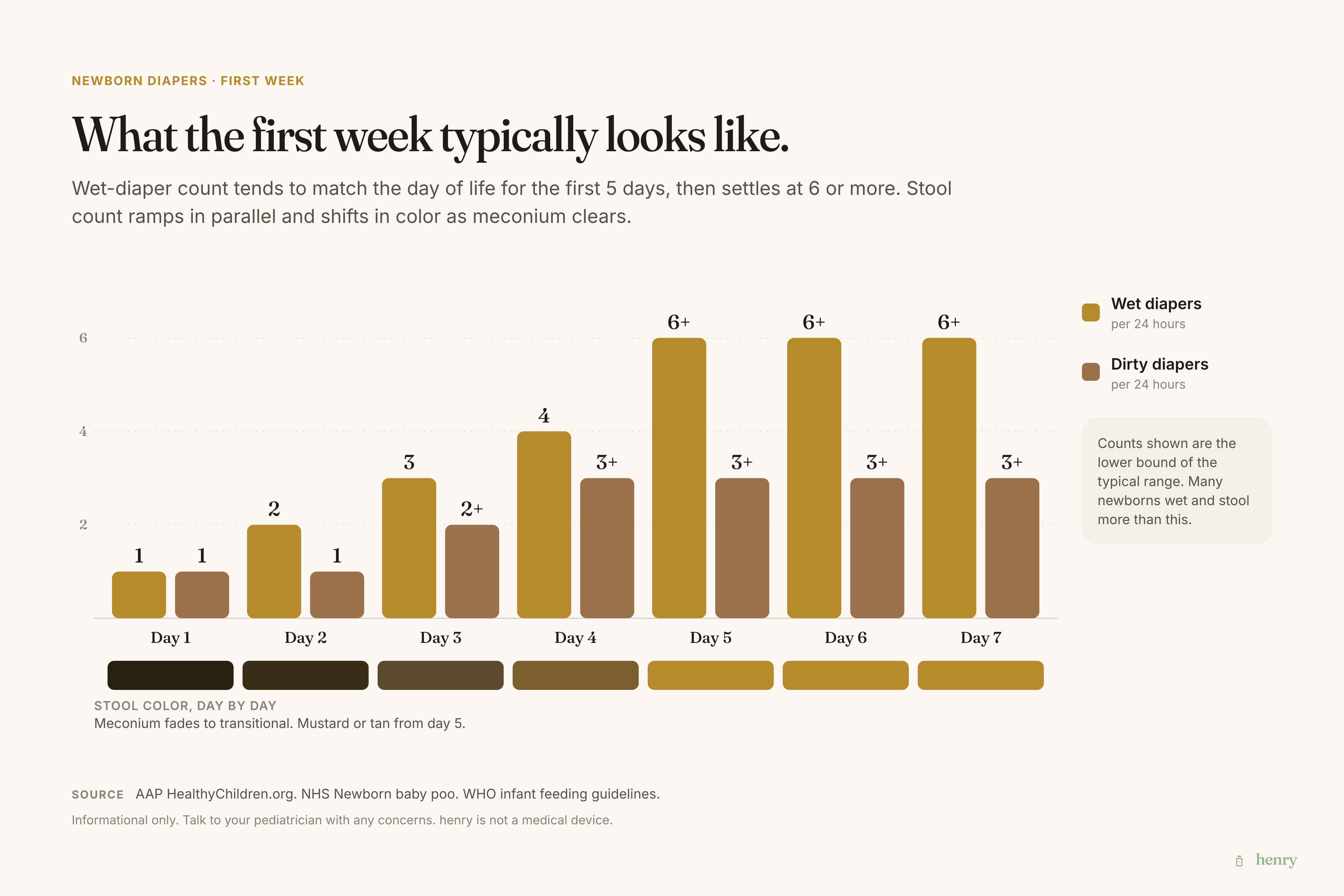
| Day | Wet diapers (24h) | Stools (24h) | What stools look like |
|---|---|---|---|
| 1 | 1+ | 1+ | Black, sticky, tar-like (meconium) |
| 2 | 2+ | 1–2 | Still meconium, transitioning |
| 3 | 3+ | 2–3 | Greenish-brown, looser (transitional) |
| 4 | 4+ | 3+ | Lighter, more yellow if breastfed |
| 5+ | 6+ | 3+ breastfed, 1–2+ formula | Yellow and seedy (breastfed); tan or brown (formula) |
Sources: AAP HealthyChildren.org, NHS Newborn baby poo, WHO infant feeding guidelines.
From week two
After about the second week the diaper math stabilizes.
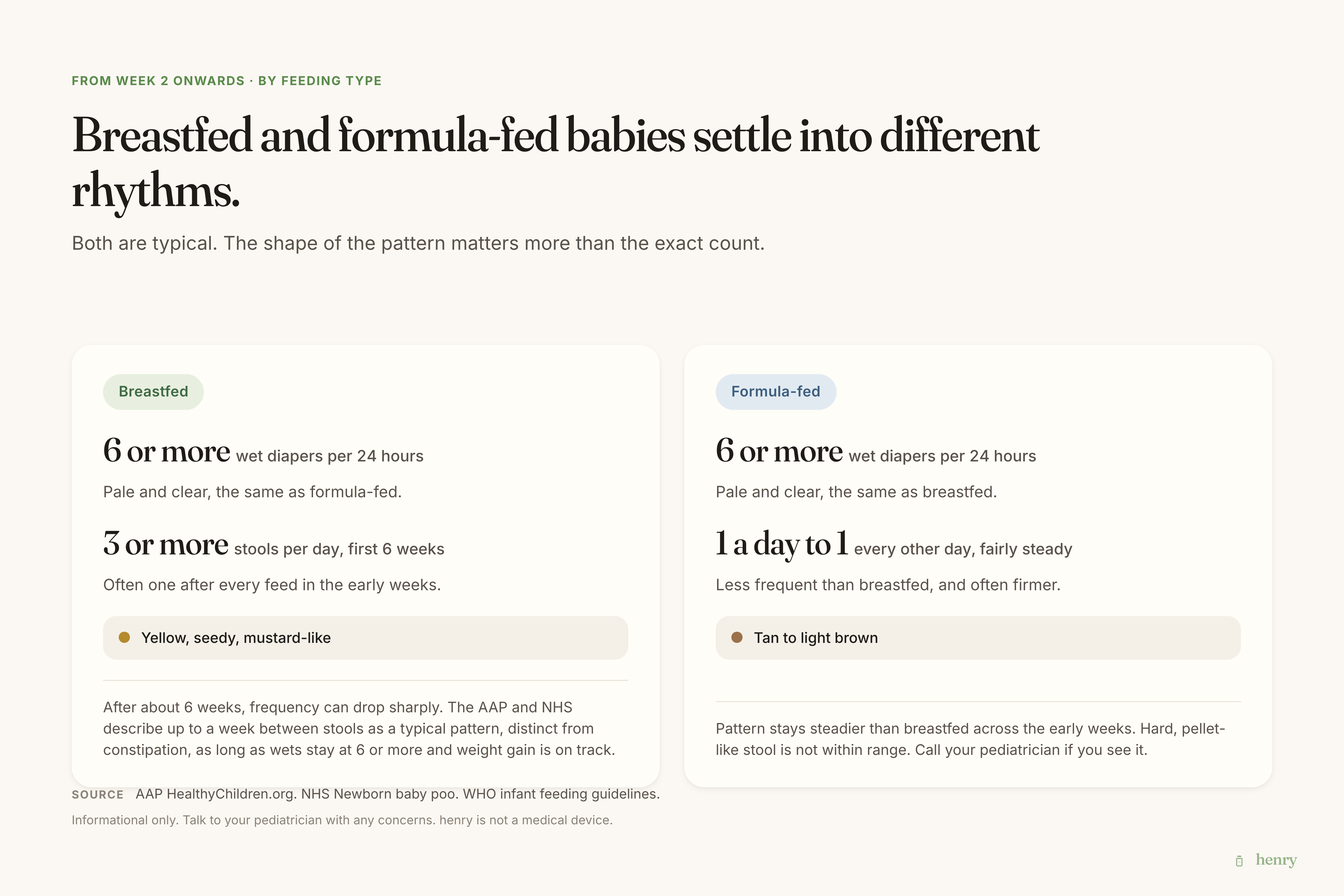
- Wet diapers: six or more per 24 hours, regardless of how your baby is fed.
- Stools, breastfed: three or more per day in the first six weeks, often one after every feed. After six weeks the rules change. See below.
- Stools, formula-fed: anywhere from one a day to one every other day. Less frequent than breastfed, often firmer.
The numbers are starting points, not targets. What changes day to day is part of the picture. What you're looking for is consistency across the week, paired with the other signals from the How much milk should a newborn eat? piece: alert behavior, weight regain by two weeks, calm between feeds.
After six weeks, breastfed babies are different
This one trips up almost every new parent the first time it happens. Around six weeks, an exclusively breastfed baby's stool frequency can drop dramatically. The AAP and NHS both note that it's normal for a breastfed baby past six weeks to go up to a week between stools, sometimes longer.
The breast milk is being absorbed almost completely, with little waste left to pass. The AAP and NHS describe this as a normal pattern, distinct from constipation, provided the baby is feeding well, producing six or more wet diapers a day, and gaining weight. If any of those signals look off, call your pediatrician.
When the stool does arrive, it can be enormous. Plan accordingly.
What color tells you
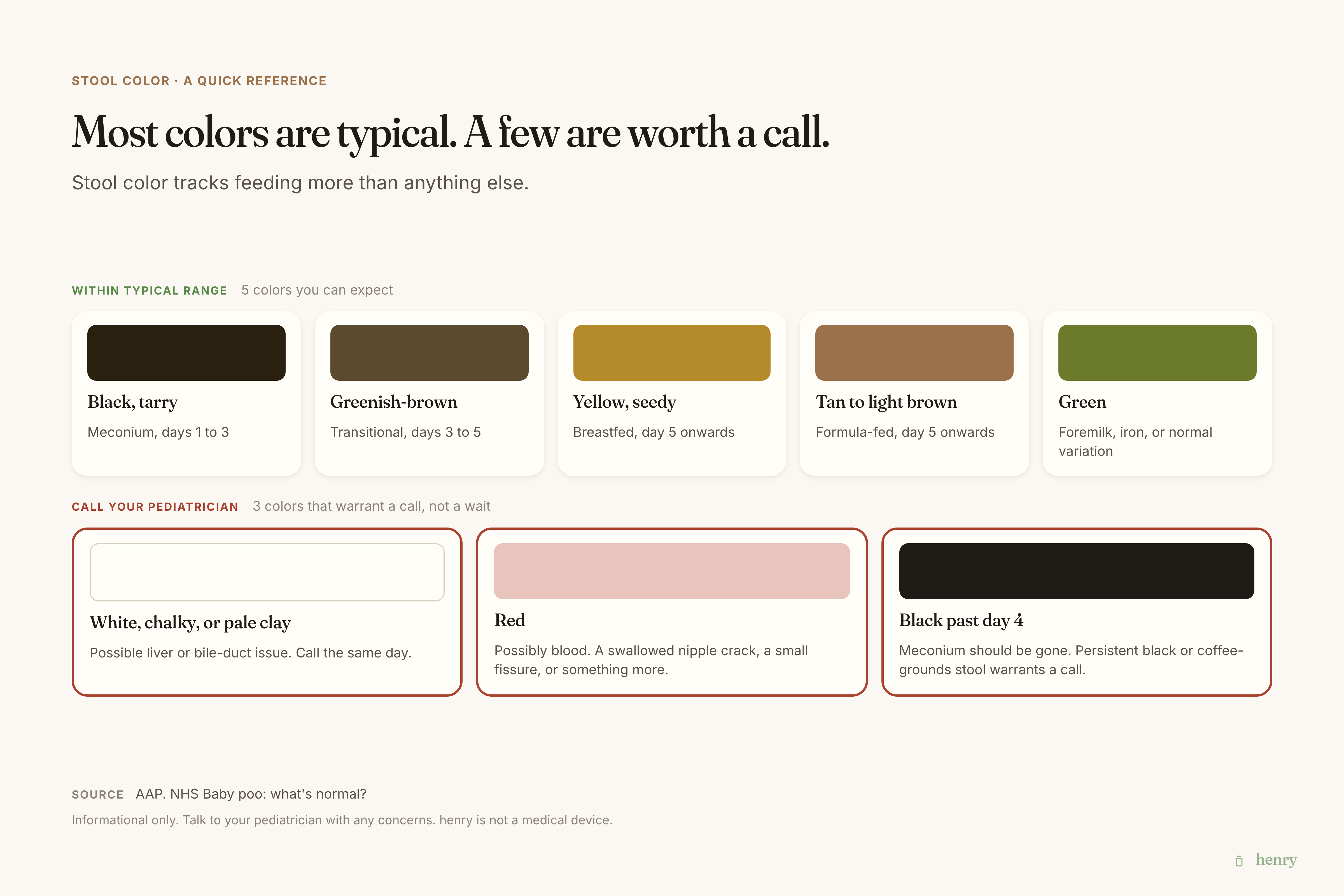
Stool color tracks feeding more than anything else. The big picture:
- Black and tarry, days 1–3. Meconium. Expected.
- Greenish-brown, days 3–5. Transitional. Expected.
- Yellow and seedy, mustard-like. Typical for breastfed babies after day 5.
- Tan, light brown, sometimes firmer. Typical for formula-fed babies after day 5.
- Green stool. Common, often nothing to flag. Can come from a foremilk-heavy nursing pattern, an iron supplement, or normal variation.
Three colors that warrant a call:
- White, chalky, or pale clay. Can signal a liver or bile-duct issue. Call the same day.
- Red. Possibly blood. Could be a swallowed nipple crack, a small fissure, or something more serious. Call.
- Black past day four. Meconium should be gone by then. Persistent black or "coffee grounds" stool warrants a call.
Sources: AAP, NHS Baby poo: what's normal?
Wet vs. dirty: different signals
The two counts mean different things.
- Wet diapers are about hydration and intake. Fewer than six per 24 hours after the first week is the most common flag pediatricians look for.
- Stools are about digestion and feeding type. They're more variable. Fewer-than-expected stools matter most in combination with low wet count, or with behavioral changes.
Pediatricians often treat a drop in stool count as less urgent than a drop in wet count when other signals look right. If anything looks off, call.
When to call your pediatrician
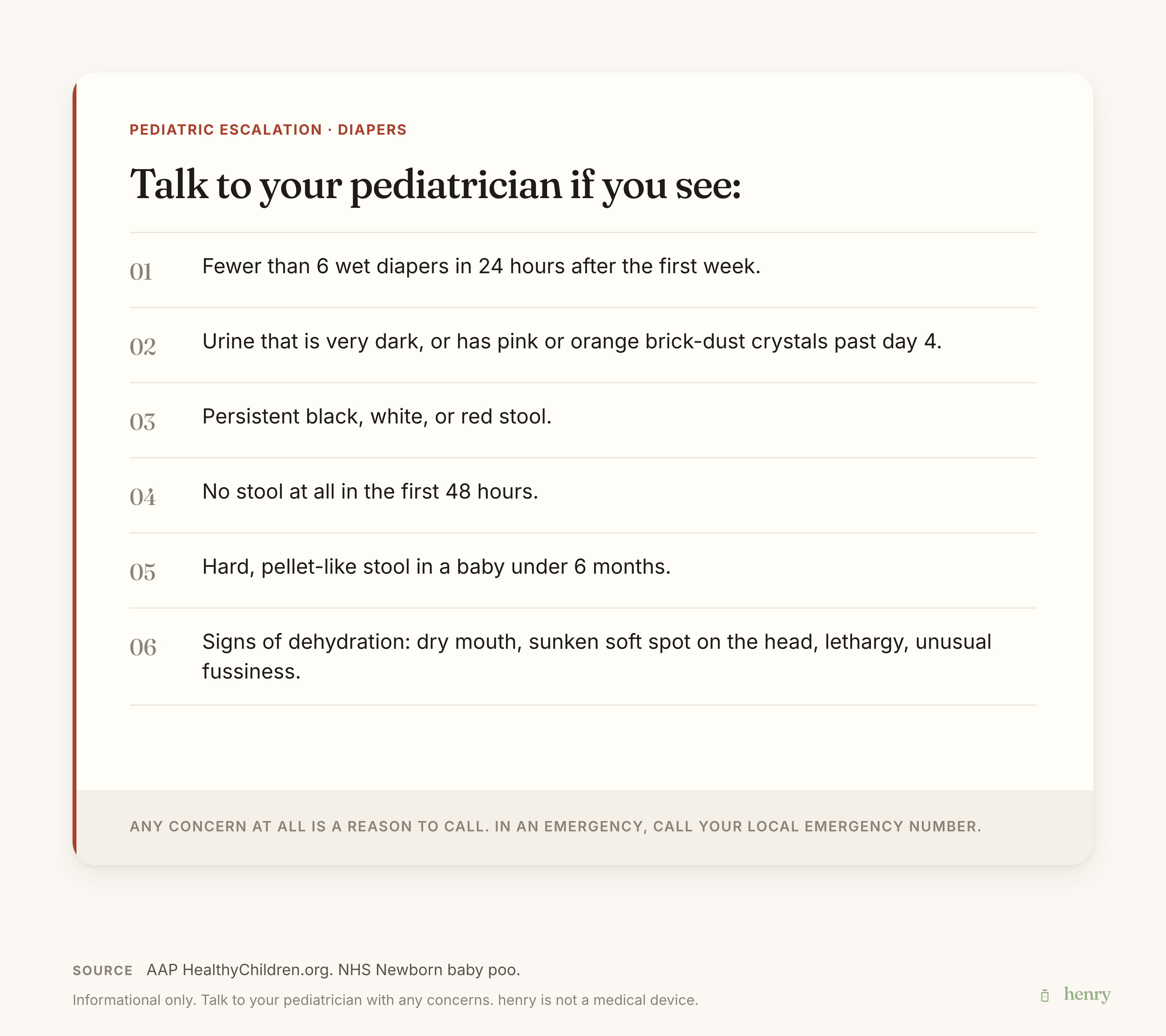
Talk to your pediatrician if any of the following are true:
- Fewer than six wet diapers in 24 hours after the first week.
- Urine that's very dark, or has pink/orange "brick dust" crystals past day four.
- Persistent black, white, or red stool.
- No stool at all in the first 48 hours.
- Hard, pellet-like stool in a baby under six months.
- Signs of dehydration: dry mouth, sunken soft spot on the head, lethargy, unusual fussiness.
- Any concern at all. Pediatricians expect calls from new parents. They would much rather take a false alarm than a delayed real one.
In an emergency, call your local emergency number.
How henry helps
henry tracks wets and poops as separate single-tap buttons on the Today screen, with size qualifiers for stools (so you can distinguish "big poop" from "mini poop" the way most parents already do). Trends shows the per-day count next to the AAP range ("after day 5: 6+ wet and 3 to 4 dirty per day is typical"), with the source cited. When your pediatrician asks "how many wets and dirties yesterday?" at the next visit, you'll have the answer without having to count.
henry is free on the App Store: henrytheapp.com.
henry shows you ranges from the American Academy of Pediatrics and the World Health Organization with their sources cited. We never tell you a number is "good" or "bad," only whether it falls inside or outside what's typical for a baby of that age. If you have any concern about your baby's feeding, growth, diapers, or health, talk to your pediatrician. In an emergency, call your local emergency number. henry is not a medical device and does not provide medical advice, a diagnosis, or a treatment plan.