By henry · June 4, 2026
Newborn sleep: what's normal?
The short answer: newborns sleep a lot, just never for long. Most sleep 14 to 17 hours across a full day in the first months, broken into stretches of two to four hours, around the clock (National Sleep Foundation; AAP HealthyChildren.org). The exhausting part is not the total. It is that the sleep is scattered across the day and night with no pattern yet, and yours is scattered with it.
henry is a tracking tool, not a diagnostic device. The ranges in this article come from publicly available pediatric guidelines (AAP, NHS, NICHD Safe to Sleep, National Sleep Foundation). Every baby is different. Always talk to your pediatrician with any concerns about your baby's sleep, breathing, or feeding.
3am, again
It is 3am. The baby went down at 1. You did the math on the couch: if they sleep until 4, that is three hours, which feels like a holiday. At 2:50 there is a snuffle, then a cry. You are up. Feed, change, wait for the eyes to close, lower them into the bassinet one vertebra at a time, back in bed at 3:40. The next feed is already somewhere ahead of you in the dark.
This is not a sleep problem. This is a newborn. The pattern, such as it is, has a shape worth knowing.
How much they sleep
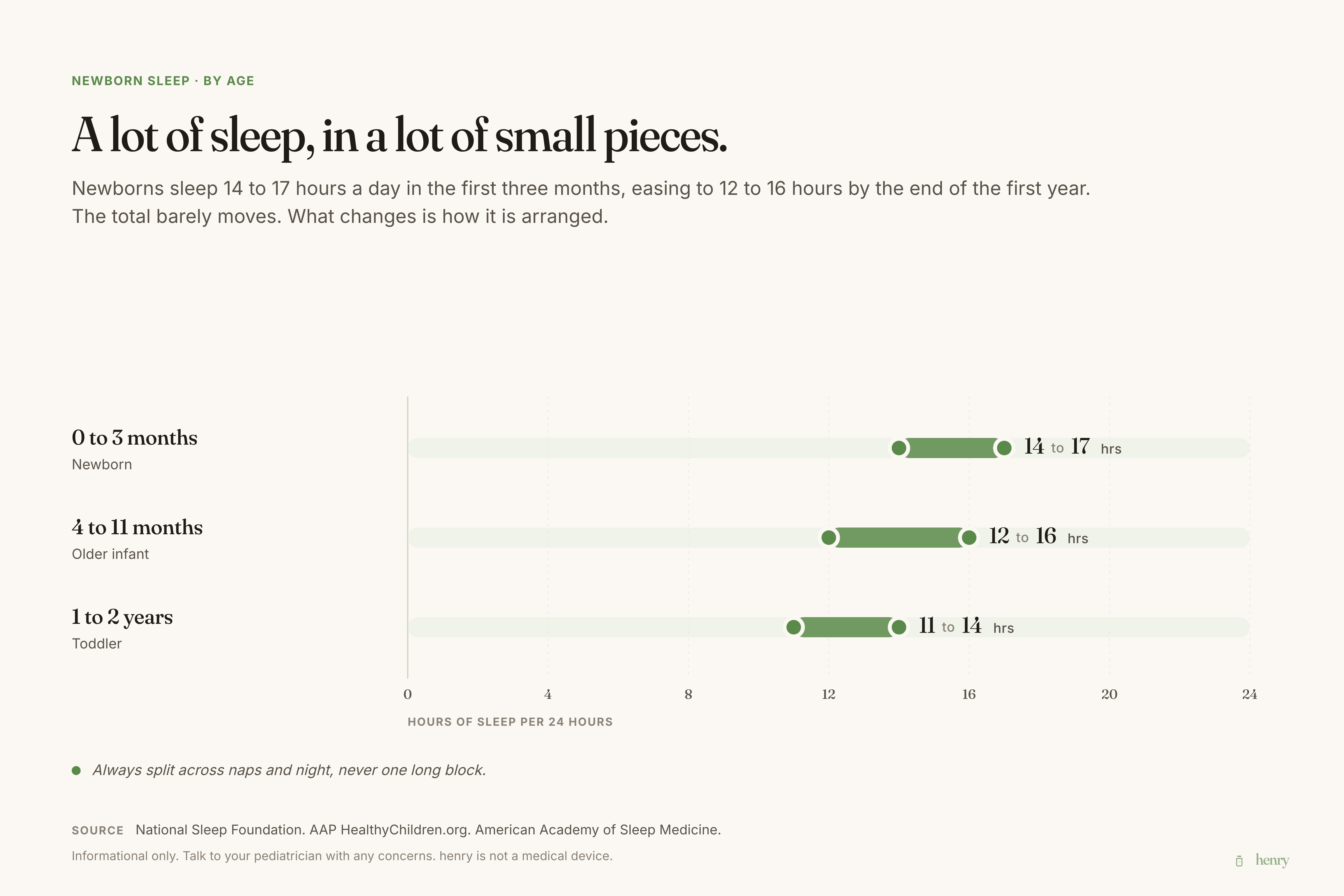
Newborns sleep more than they are awake. The National Sleep Foundation puts the typical range at 14 to 17 hours per 24 hours for the first three months, with some healthy babies a few hours either side. The number drifts down slowly: by 4 to 12 months, the American Academy of Sleep Medicine and the AAP put it at 12 to 16 hours including naps.
What changes faster than the total is how the sleep is arranged. In the first weeks it comes in small pieces at all hours. Over the first months those pieces get longer and start to gather at night. The total barely moves; the shape of it is what shifts.
Why it comes in pieces
Three things keep newborn sleep short.
The first is a small stomach. A newborn feeds every two to four hours, including overnight, because that is how often they empty. Hunger wakes them on roughly the same clock day and night. See How much milk should a newborn eat? for the volumes behind that rhythm.
The second is the sleep itself. Newborns spend about half their sleep in active sleep, the lighter, dream-heavy state where they twitch, grunt, flutter their eyes, and make noises. A baby in active sleep can look awake and can wake easily. Adults spend far less of the night there. This is why a newborn who seems to be stirring is often still asleep, and why picking them up too fast can end a stretch early.
The third is that the internal clock has not started yet.
Day and night look the same at first
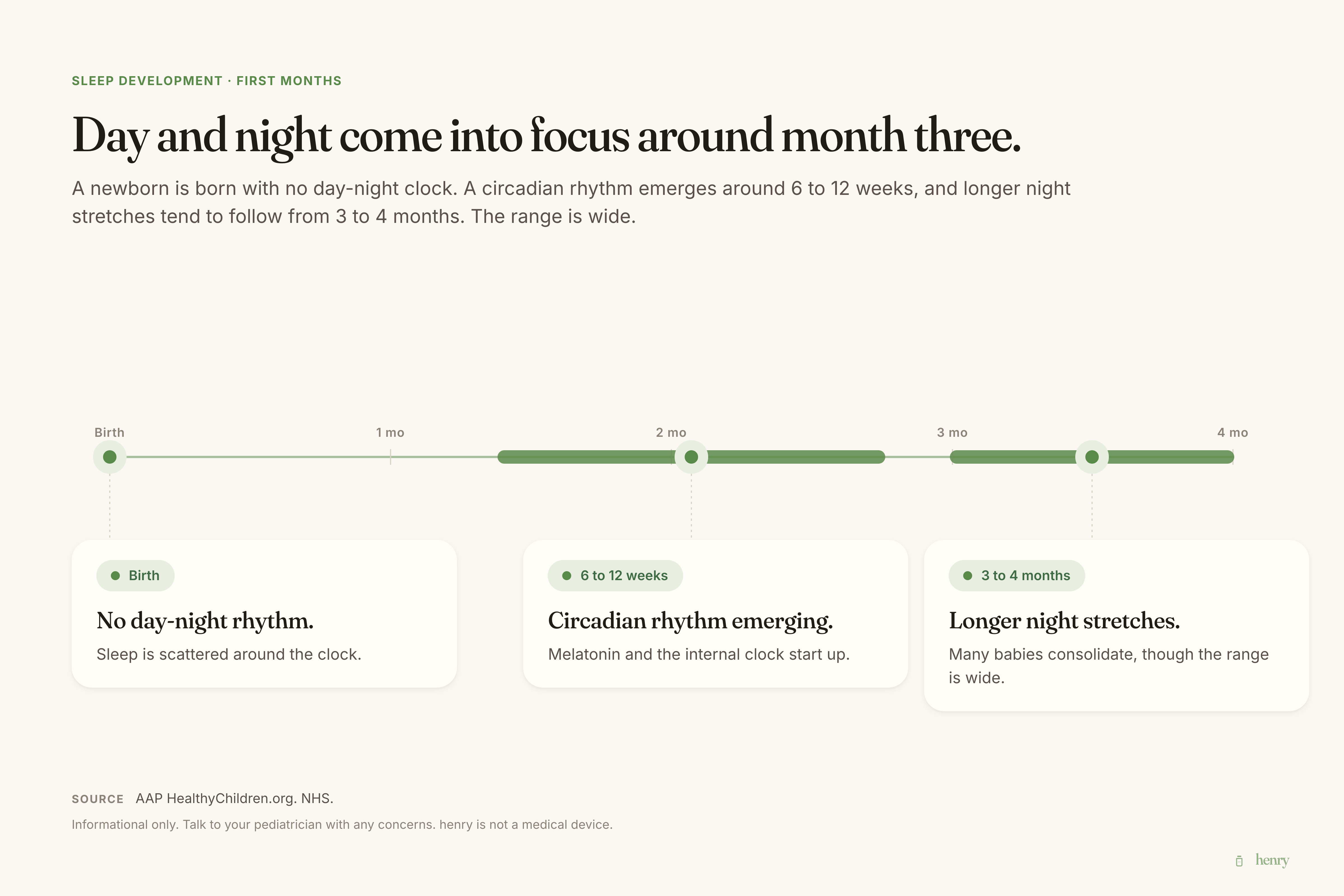
A newborn is born without a circadian rhythm. The internal day-night clock, driven in part by melatonin, develops over the first weeks and is usually emerging around 6 to 12 weeks, or two to three months (AAP HealthyChildren.org; NHS). Until then a baby genuinely does not know that 3am is different from 3pm. Day-night reversal, where the longest wakeful stretch lands in the small hours, is common and passes.
To help the clock along, the NHS suggests keeping nights dark, quiet, and low-key, and letting days be bright and full of normal household noise and activity. This nudges the rhythm without forcing it. From around 3 to 4 months many babies begin to sleep in longer stretches at night, though the range is wide and there is no set age by which it has to happen.
Safe sleep
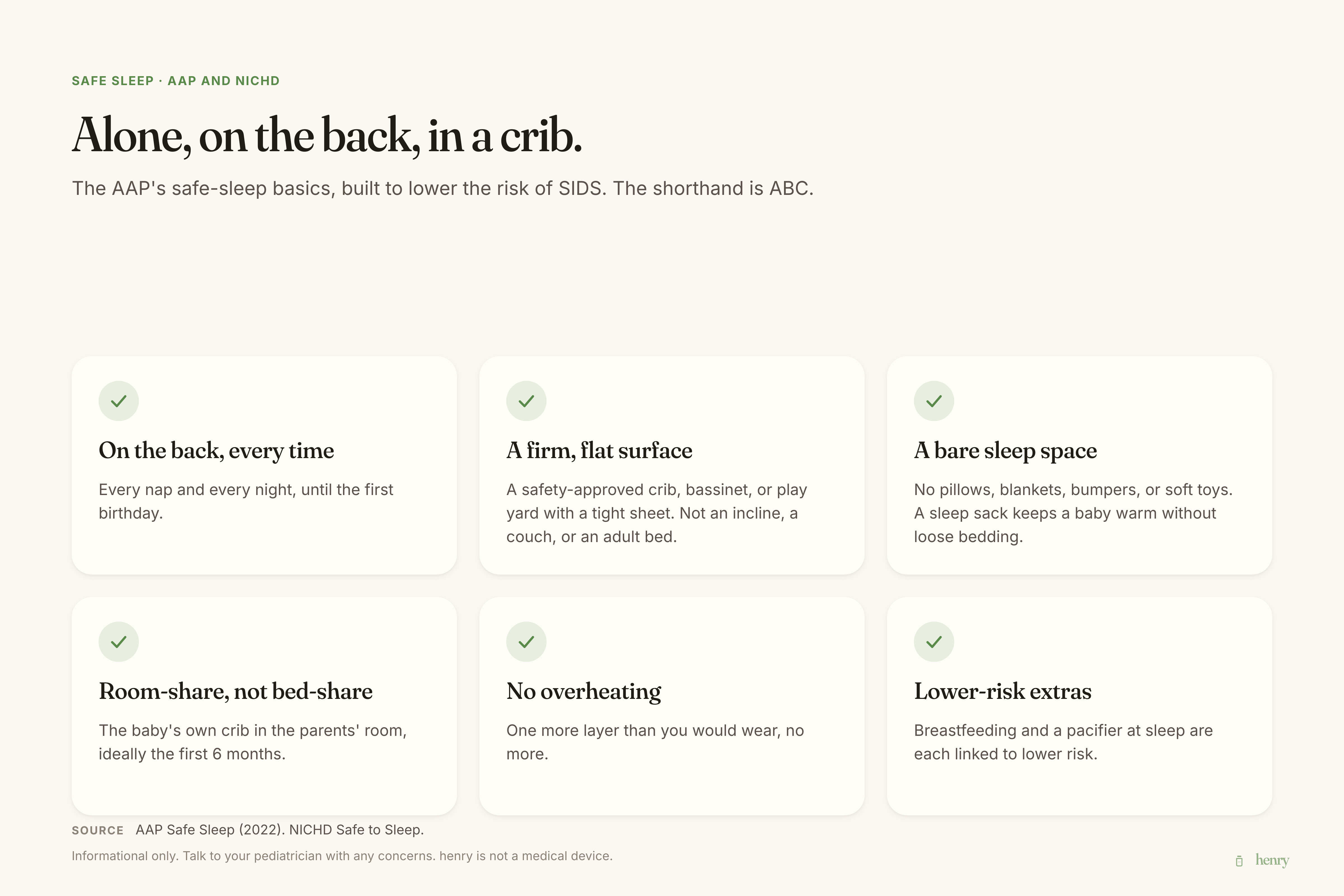
This is the part where the source matters most. The AAP's safe-sleep guidance is built around reducing the risk of sudden infant death (SIDS) and other sleep-related deaths. The campaign's shorthand is ABC: a baby sleeps Alone, on their Back, in a Crib.
The AAP and the NICHD Safe to Sleep campaign recommend:
- On the back, every time. For every nap and every night, until the first birthday. Back sleeping carries the lowest risk.
- A firm, flat surface. A safety-approved crib, bassinet, or play yard with a tight-fitting sheet and nothing else. Not an incline, a couch, or an adult bed.
- A bare sleep space. No pillows, blankets, bumpers, or soft toys. A wearable blanket or sleep sack keeps a baby warm without loose bedding.
- Room-sharing, not bed-sharing. The AAP recommends the baby sleep in their own crib or bassinet in the parents' room, ideally for the first 6 months.
- No overheating. Dress the baby in one more layer than you would wear, no more, and keep the room comfortable.
The AAP also notes that breastfeeding and offering a pacifier at sleep are each associated with lower SIDS risk. If anything about your baby's sleep setup is unclear, talk to your pediatrician before changing it.
Waking to feed, and when it eases
In the first weeks, a newborn should not go too long without feeding, even overnight, until they are back above their birth weight and gaining (AAP). Your pediatrician will tell you when it is fine to stop waking them and let a longer stretch happen on its own. After that, the longer nights tend to arrive gradually, one extended stretch at a time.
Evenings can be their own thing. A baby who is hard to settle at night, feeding in short bursts before bed, may be cluster feeding rather than fighting sleep. See Cluster feeding: what's normal? for what that looks like.
When to call your pediatrician
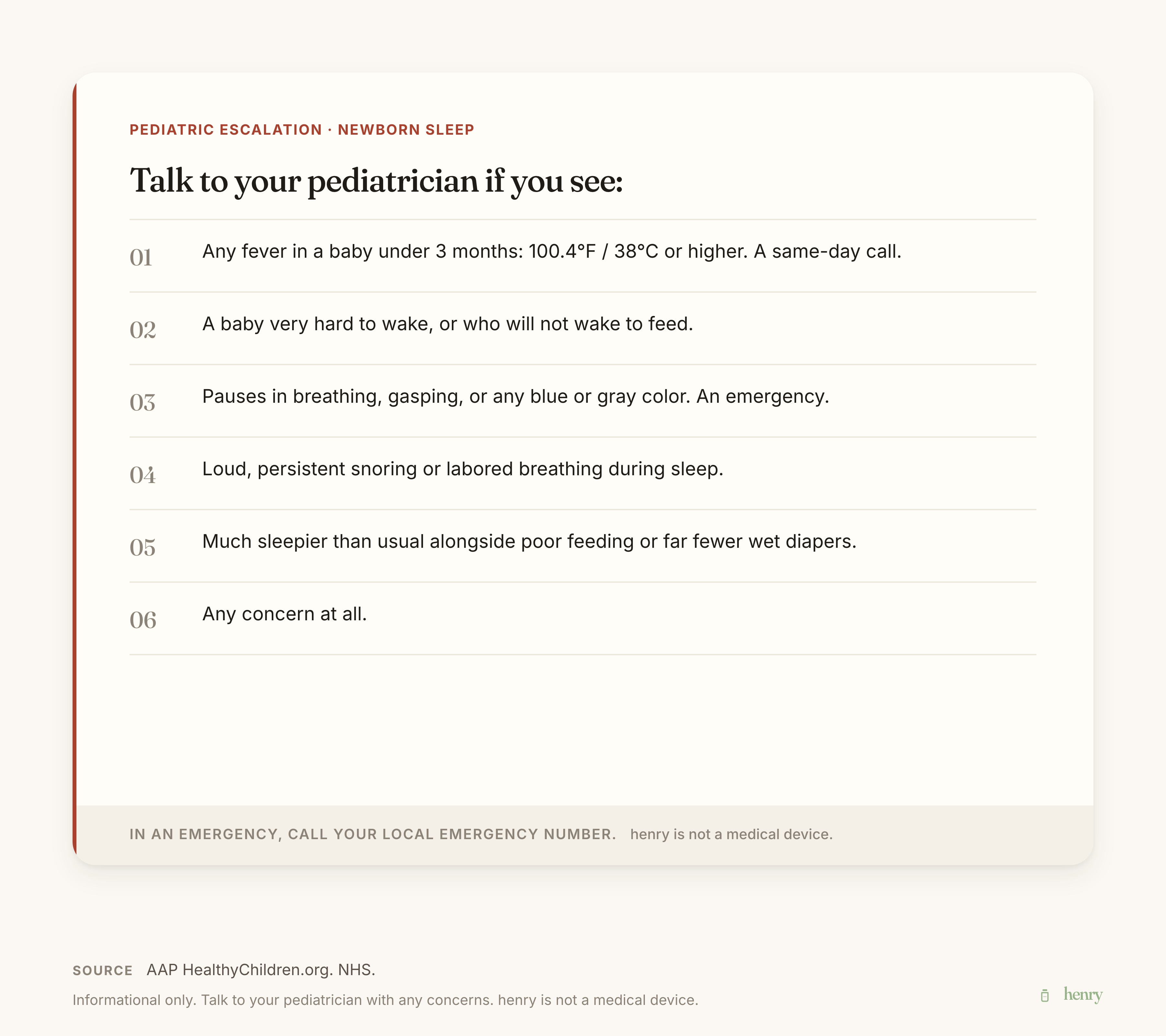
Most newborn sleep is just newborn sleep. A few patterns are worth a call.
- Any fever in a baby under 3 months. A temperature of 100.4°F / 38°C or higher in a newborn is a same-day call, sleeping or not. The AAP treats fever in this age group as urgent.
- A baby who is very hard to wake, or will not wake to feed. Newborns are sleepy, but they should rouse to feed and have periods of alertness. A baby who is unusually limp, sleeps through feeds, and is making far fewer wet diapers than usual needs to be seen.
- Pauses in breathing, gasping, or a change in color. Brief irregular newborn breathing is common. Long pauses, struggling to breathe, or any blue or gray color around the lips is an emergency.
- A sudden change in how much they sleep alongside other signs. Much sleepier than usual plus poor feeding, fewer wet diapers, or a fever is different from a baby who simply had a long nap.
- Any concern at all. Pediatricians would rather take a call about a sleepy newborn than miss one.
In an emergency, call your local emergency number.
How henry helps
henry does not track sleep. It tracks feeds, pumps, pees, and poops. That is a deliberate line, not a gap we forgot to fill.
But newborn sleep is built around feeds, and the overnight feed log is the closest thing you have to a record of the night: when the baby woke, how much they took, whether they settled after. When you and your co-parent are both logging, the 3am feed is written down before either of you forgets it, and the next morning the night is not a blur. You can see that the long stretch is slowly creeping later, week over week, in the timestamps.
henry will not tell you when your baby will sleep through the night. No app can, and anyone who promises otherwise is guessing. What it can show you is the feeding the sleep is organized around.
henry is free on the App Store: henrytheapp.com.
henry shows you ranges from the American Academy of Pediatrics, the NHS, the NICHD Safe to Sleep campaign, and the National Sleep Foundation with their sources cited. We never tell you a number is "good" or "bad," only whether it falls inside or outside what's typical for a baby of that age. If you have any concern about your baby's sleep, breathing, feeding, or health, talk to your pediatrician. In an emergency, call your local emergency number. henry is not a medical device and does not provide medical advice, a diagnosis, or a treatment plan.