By henry · May 27, 2026
Cluster feeding: what's normal?
The short answer: a baby taking many short feeds in close succession, usually in the evening, usually during a growth spurt. It looks alarming because nothing about it follows the schedule you thought you understood yesterday. The American Academy of Pediatrics and La Leche League both describe it as a normal newborn pattern, not a sign of low milk supply or an underfed baby.
henry is a tracking tool, not a diagnostic device. The ranges in this article come from publicly available pediatric guidelines (AAP, NHS, La Leche League International). Every baby is different. Always talk to your pediatrician with any concerns about your baby's feeding, output, or growth.
The 7pm version
It's 7pm. Your baby just finished a feed twenty minutes ago. They're back on the breast or bottle, fussing and rooting like they haven't eaten in hours. You check your tracker: fourth feed since 5pm. Your partner walks in and says "isn't she eating again?" You don't have a good answer.
You're not alone, and you're not doing it wrong. Cluster feeding is its own thing. It's common, expected at certain ages, and usually passes within a day or two. What you're seeing is not a problem to solve. It's a phase to track.
What there is, though, is a pattern.
What cluster feeding looks like
A baby taking several short feeds back-to-back over a few hours, instead of one full feed every few hours.
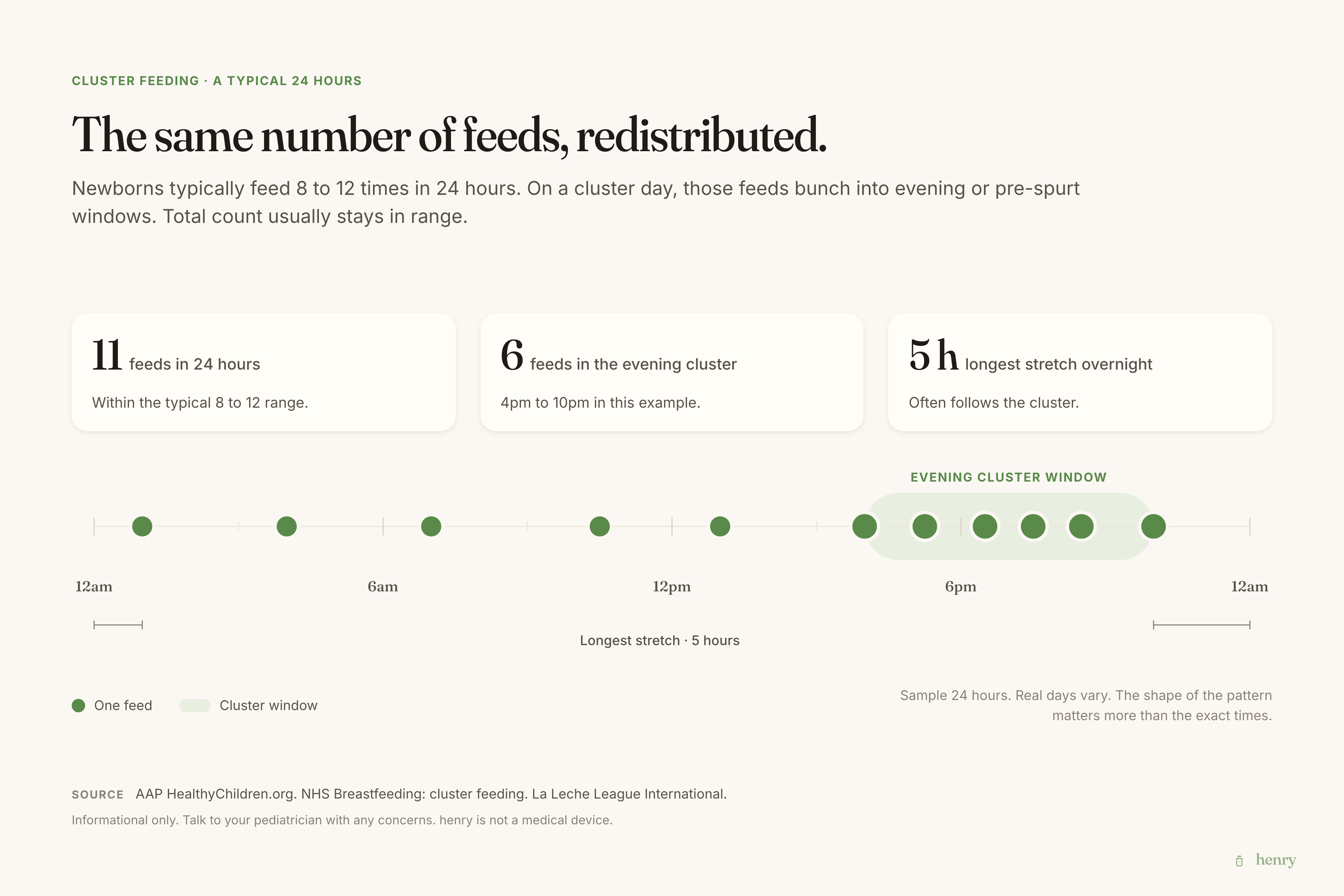
The bookkeeping:
- 30 to 60 minutes between feeds, sometimes less.
- Often evenings, but can happen any time of day.
- Each feed shorter than usual.
- Baby alternates feeding, dozing, fussing, feeding again.
- Usually lasts a few hours, then a longer sleep stretch.
Most clusters happen in the late afternoon and evening. La Leche League describes the "evening fuss" as one of the most common contexts: a baby who was calm all day suddenly seems insatiable from 5pm onward, then settles for a longer sleep stretch overnight.
Why babies do it
There are two reasons, and both can be at play at once.
Milk supply signaling (breastfeeding). La Leche League describes the lactation feedback loop: frequent feeding tells the body to make more milk over the next 24 to 48 hours. Cluster feeding during a growth spurt is the body ordering more supply for tomorrow.
Comfort and bonding. Babies cluster-feed when they're tired, overstimulated, or settling into a sleep window. The breast or bottle is hunger plus comfort plus warmth plus closeness. Especially in the evening, after a day of noise, the cluster feed is also a baby asking to be held.
Formula-fed babies cluster less often because formula digests more slowly and bottle feeds tend to be larger and more spaced. But formula-fed babies still comfort-cluster, particularly in the evenings.
When it happens (the growth spurts)
Cluster feeding is most common during growth spurts. The AAP and La Leche League both note the same approximate windows.
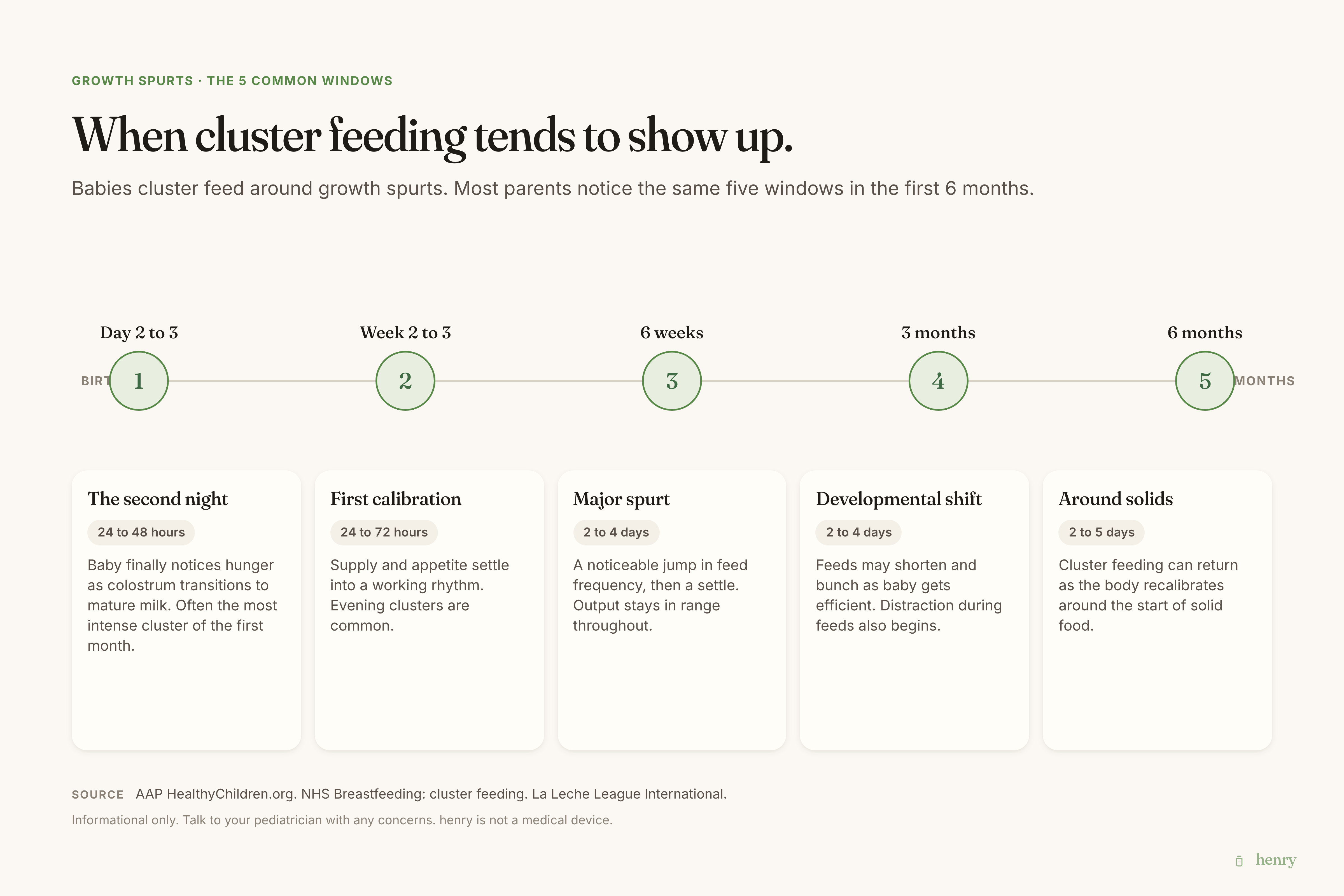
- Days 3 to 7. The first one, often as milk supply transitions.
- Around 3 weeks.
- Around 6 weeks.
- Around 3 months.
- Around 6 months.
Each spurt typically lasts 24 to 72 hours, sometimes a little longer. Then the baby settles back to their previous pattern, often with a slightly bigger appetite per feed.
Sources: La Leche League International, Growth spurts; AAP HealthyChildren.org.
Breastfed vs. formula-fed
The mechanics are different. The experience for the parent is similar.
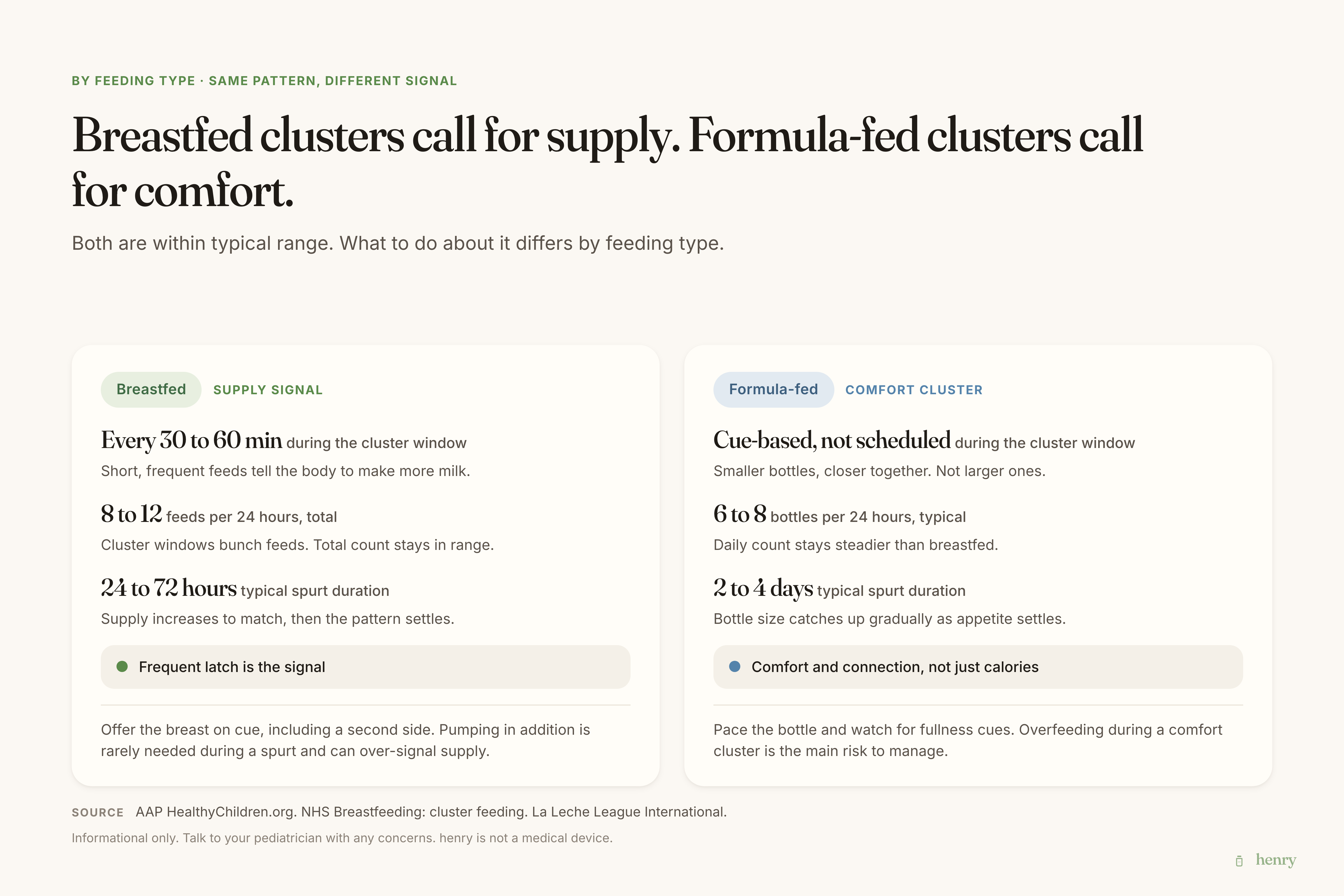
Breastfed. The cluster is the system working as designed. La Leche League and most lactation consultants recommend feeding on demand during clusters. Supplementing with formula or skipping feeds to lengthen the gap is a conversation to have with your pediatrician or lactation consultant before doing, not a default move. La Leche League notes that supplementing during a cluster can interrupt the supply signal and shorten the next phase of supply.
Formula-fed. Clusters still happen, especially in the evening. The AAP describes a similar approach: respond to hunger cues. Overfeeding signs (spit-up after every feed, baby pulling away from the bottle and refusing) are worth flagging to your pediatrician.
In both cases, the feeding-amount ranges from How much milk should a newborn eat? and the wet-diaper and stool counts from How many wet and dirty diapers should a newborn have? still apply. Six or more wets per 24 hours after the first week, weight on track, alert behavior between feeds. Those signals are how you know the cluster is normal.
What is NOT cluster feeding
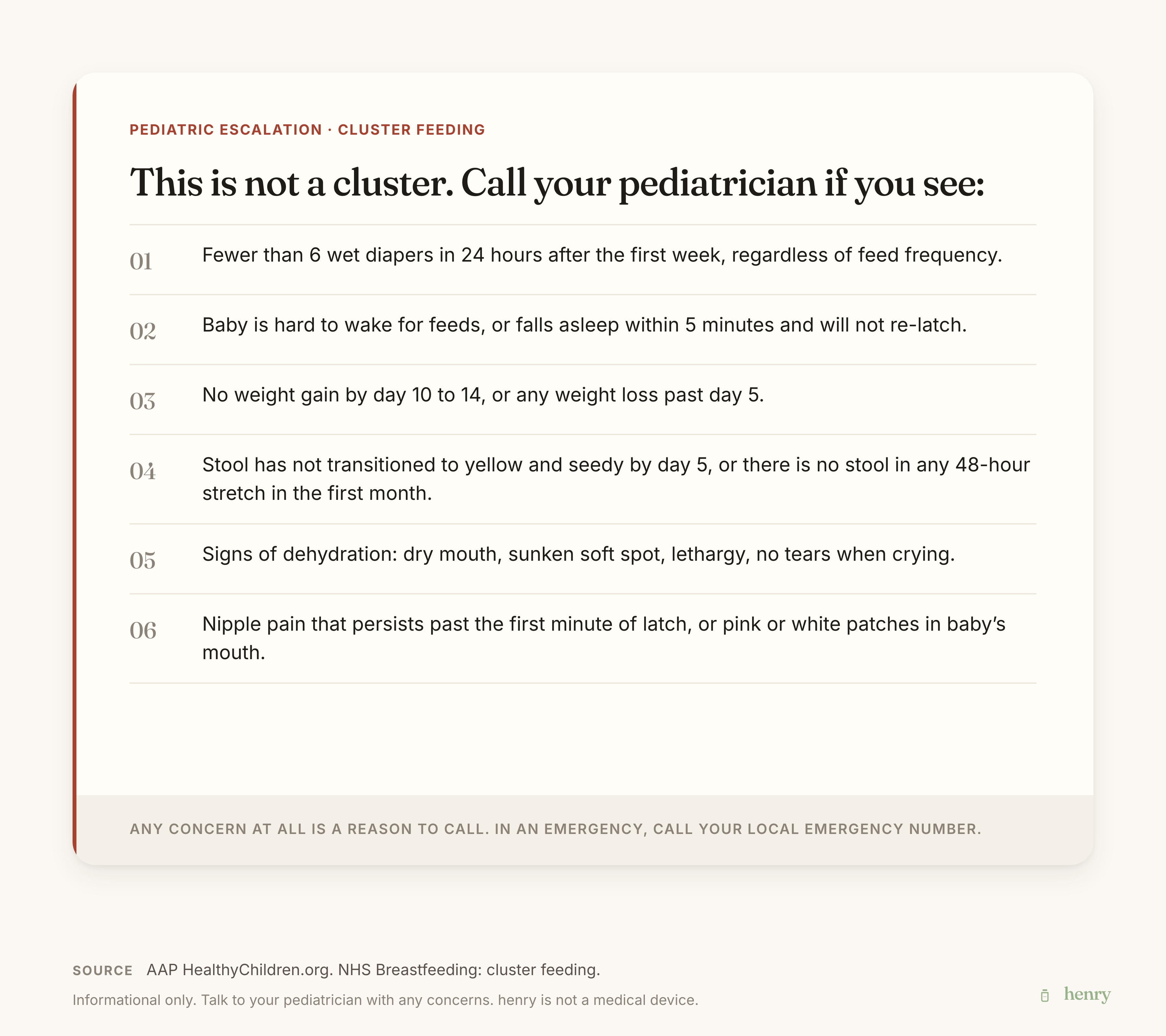
Some patterns look like cluster feeding but aren't, and warrant a call.
- Inconsolable crying that feeding doesn't soothe. Hunger cues should respond to a feed.
- Fewer than six wet diapers in 24 hours after the first week. Cluster feeds in, no wets out is the wrong shape.
- No weight gain by the two-week visit, or weight loss continuing past day 7.
- Refusing feeds entirely, not just shorter feeds.
- Persistent fussing during feeds for more than a few days, especially with gulping, arching, or spit-up.
- A cluster that doesn't end after 3 to 4 days, with no corresponding settle period.
Talk to your pediatrician about any of the above. Pediatricians expect calls from new parents. They would much rather take a false alarm than a delayed real one.
In an emergency, call your local emergency number.
How henry helps
henry logs each feed as you go, with timestamps. The Today view shows the gap between feeds at a glance, so you can see a cluster forming in real time and know it's a cluster, not a forgotten feed. Trends shows the daily feed volume next to the AAP range ("roughly 150 to 200 ml/kg/day"), with the source cited; a cluster day reads as a normal-volume day spread over more feeds rather than as a spike. When your pediatrician asks "what did the evening look like?" at the next visit, you'll have the timestamps.
henry is free on the App Store: henrytheapp.com.
henry shows you ranges from the American Academy of Pediatrics and the World Health Organization with their sources cited. We never tell you a number is "good" or "bad," only whether it falls inside or outside what's typical for a baby of that age. If you have any concern about your baby's feeding, growth, diapers, or health, talk to your pediatrician. In an emergency, call your local emergency number. henry is not a medical device and does not provide medical advice, a diagnosis, or a treatment plan.