By henry · July 5, 2026
Newborn hiccups: what's normal?
The short answer: newborn hiccups are so normal that your baby was doing them before they were born. Those rhythmic pops you felt in month eight of pregnancy were these exact hiccups. Newborns hiccup often, usually after feeds, and the NHS and AAP both describe them as harmless, painless, and far more bothersome to the parent watching than to the baby having them. Most babies hiccup less and less over the first year as the diaphragm and nervous system mature.
henry is a tracking tool, not a diagnostic device. The guidance in this article comes from publicly available pediatric sources (AAP, NHS). Every baby is different. Always talk to your pediatrician with any concerns about your baby's feeding, breathing, or comfort.
The loudest thing in the room
The bottle is done. The burp happened. The baby is asleep on your chest, and then: hic. Hic. Hic. Loud enough to hear across the room, regular as a metronome, shaking their whole tiny torso. You freeze. You google with one thumb. You consider waking them to fix it.
Look down first. The baby is still asleep. That is the entire diagnosis. Newborns routinely sleep through their own hiccups, feed through them, and stare at the ceiling fan through them. The distress in the room is yours.
Why so many hiccups
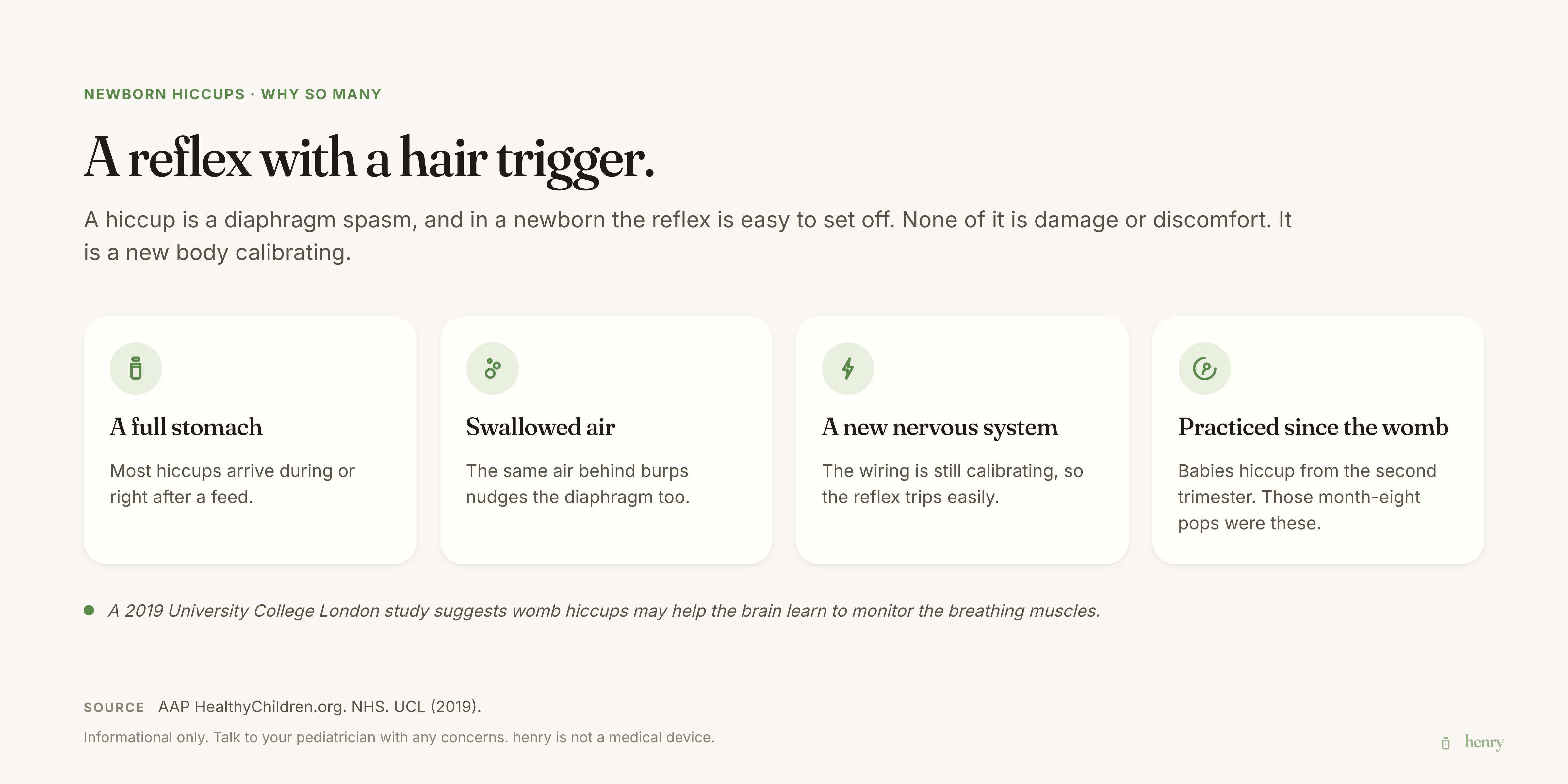
A hiccup is a spasm of the diaphragm, the muscle that drives breathing, followed by the vocal cords snapping shut. That is the "hic." In newborns the reflex is easy to set off:
- A full stomach. Most newborn hiccups arrive during or right after a feed, when the stomach stretches against the diaphragm sitting directly above it.
- Swallowed air. The same air behind burps and gas nudges the diaphragm too.
- An immature nervous system. The wiring that regulates the diaphragm is still calibrating, so the reflex trips easily. This is also why hiccups fade with age.
- Long practice. Babies hiccup in the womb from the second trimester. A 2019 University College London study suggested those hiccups may even help the developing brain learn to monitor the breathing muscles. Hiccups, in other words, may be homework.
None of this is damage, discomfort, or a sign of anything wrong. It is a reflex with a hair trigger, in a body where every system is new.
What helps, and what to skip
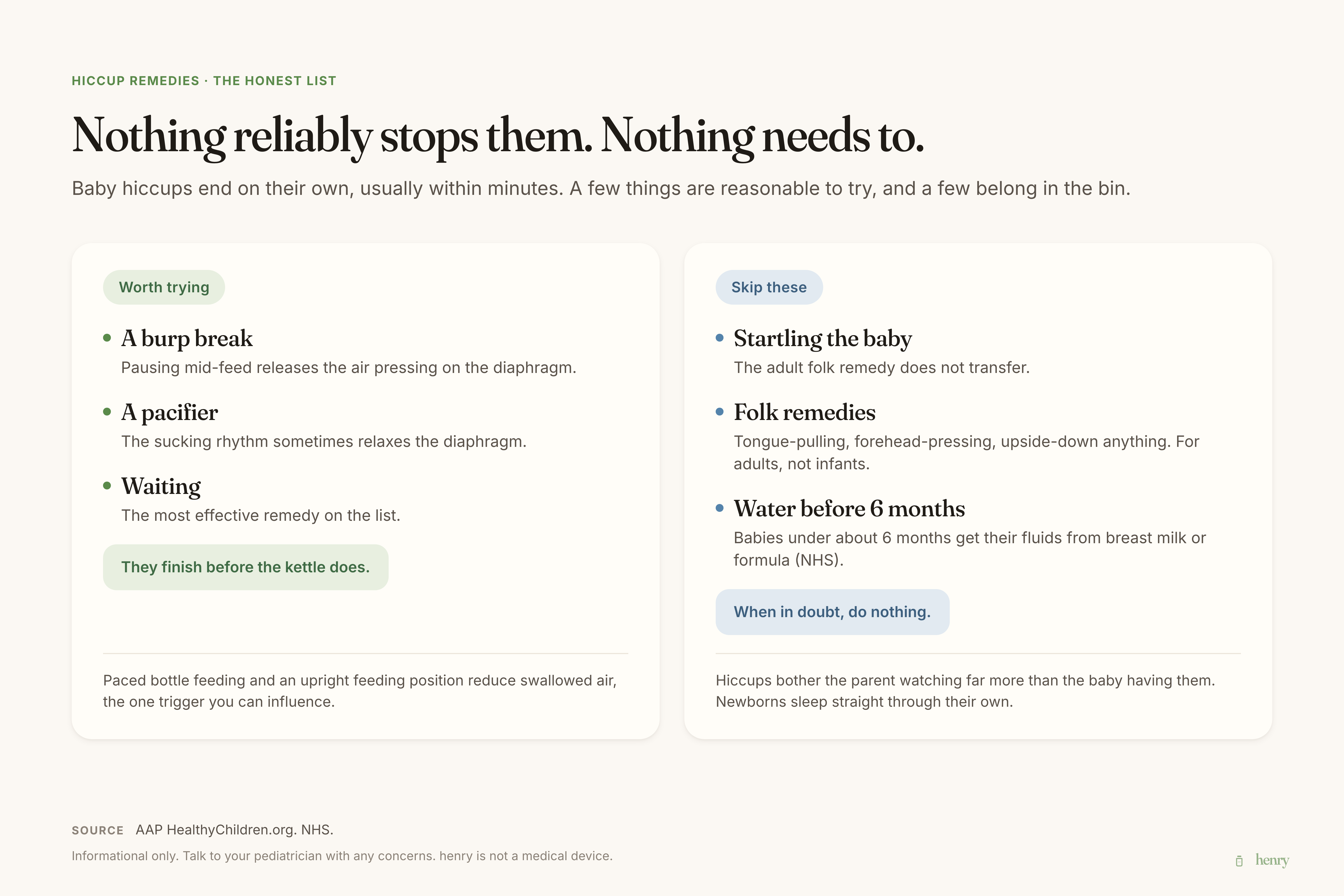
Honest version first: nothing reliably stops baby hiccups, and nothing needs to. They end on their own, usually within minutes. A few things are reasonable to try, and a few belong in the bin.
Worth trying:
- A burp break. Pausing mid-feed to burp can release the air pressing on the diaphragm. Burping a newborn: what's normal? covers the positions.
- A pacifier. The sucking rhythm sometimes relaxes the diaphragm.
- Waiting. The most effective remedy on the list. The hiccups will finish before the kettle does.
Skip these:
- Startling or scaring the baby. The adult folk remedy does not transfer, and a startled newborn gains nothing.
- Pulling the tongue, pressing the forehead, upside-down anything. Folk remedies for adults, not interventions for infants.
- Water. Babies under about 6 months get their fluids from breast milk or formula, full stop (NHS). Sips of water are not a hiccup treatment for a young infant.
If a feed-time pattern bugs you, paced bottle feeding and a calmer, more upright feeding position reduce swallowed air, which is the one trigger you can actually influence.
When hiccups travel with other things
On their own, hiccups in the first year are noise, not signal. The only time they earn a mention is when they consistently arrive with company:
- Hiccups plus frequent spit-up, arching, and feeding distress. Constant hiccuping alongside reflux symptoms can be part of the GERD picture, which is the pediatrician's call. Spit-up and reflux: what's normal? covers where that line sits.
- Hiccups that regularly interfere with feeding or sleep. Not the baby snoozing through them; a baby who genuinely cannot feed or settle because of them, often.
- Still hiccuping constantly well past the first birthday. Worth raising at a checkup, not urgently.
- Anything with breathing trouble or color change. That is never a hiccups question. In an emergency, call your local emergency number.
Notice what this list is: patterns over weeks, plus one emergency that is not really about hiccups. There is no same-day hiccup call. Pediatricians would tell you that themselves, usually while the baby in question hiccups peacefully on the exam table.
How henry helps
henry does not have a hiccup tracker, and a hiccup tracker would be a parody of an app like this. What henry has is the feed log with a note field, and that is where hiccups occasionally earn their keep: "hiccups after every bottle this week" written on the feed is the kind of pattern your pediatrician can actually use, with timestamps, if the hiccups ever do travel with reflux signs. For the other 99% of hiccups, the correct entry is no entry. Put the phone down and watch them sleep through it.
henry is free on the App Store: henrytheapp.com.
henry shows you ranges from the American Academy of Pediatrics, the NHS, and other cited public sources. We never tell you a number is "good" or "bad," only whether it falls inside or outside what's typical for a baby of that age. If you have any concern about your baby's feeding, breathing, comfort, or health, talk to your pediatrician. In an emergency, call your local emergency number. henry is not a medical device and does not provide medical advice, a diagnosis, or a treatment plan.