By henry · May 30, 2026
Burping a newborn: what's normal?
The short answer: most babies swallow some air while feeding, and burping helps it come up. The AAP and NHS both describe burping as helpful but not strictly required, especially for breastfed babies who tend to swallow less air. Some babies burp the moment you lift them. Others never produce one and are fine. The signal you're looking for is comfort, not the burp itself.
henry is a tracking tool, not a diagnostic device. The ranges in this article come from publicly available pediatric guidelines (AAP, NHS, La Leche League). Every baby is different. Always talk to your pediatrician with any concerns about your baby's feeding, output, or comfort.
The five-minute wait
It's 11pm. The bottle is done. You sit your baby upright, support the chin and chest with one hand, and start patting their back with the other. One minute. Two minutes. Three. Nothing. You try the over-the-shoulder. Nothing. You lay them across your lap face-down. A small grunt, no burp. You give up and put them down. Twenty minutes later: a wail, a tiny burp, and a wet patch on the swaddle.
You're not alone, and you're not doing it wrong. Babies don't burp on cue. Some need a minute, some need ten, some don't need it at all. The American Academy of Pediatrics' position is that burping is helpful, not mandatory. If a baby is calm and content after a feed, the burp is optional.
What there is, though, is a pattern.
Why burping matters (sometimes)
Babies swallow air while feeding. The air sits in the stomach, takes up space, and can make a baby feel full before they're done. It can also come back up later mixed with milk, which is what we call spit-up.
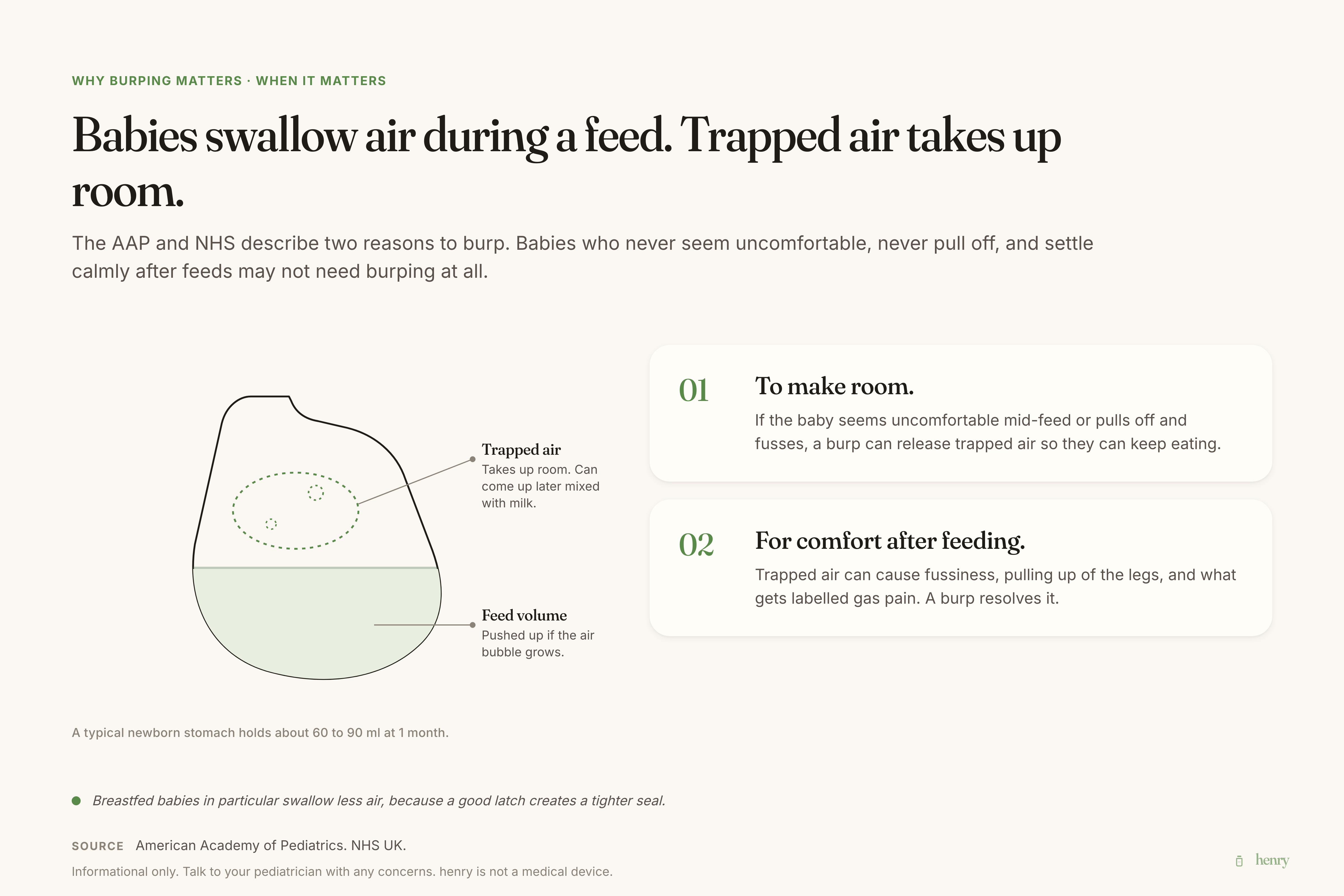
The AAP and NHS describe two reasons to burp:
- To make room. If a baby seems uncomfortable mid-feed or pulls off and fusses, a burp can release trapped air so they can keep eating.
- For comfort after feeding. Trapped air can cause fussiness, pulling up of the legs, and what gets labeled "gas pain." A burp resolves it.
Babies who never seem uncomfortable, never pull off, and settle calmly after feeds may not need burping at all. The AAP explicitly notes this. Breastfed babies in particular swallow less air than bottle-fed babies because the latch creates a tighter seal.
Breastfed vs. formula-fed
The mechanics are different. The burping practice that follows is different.
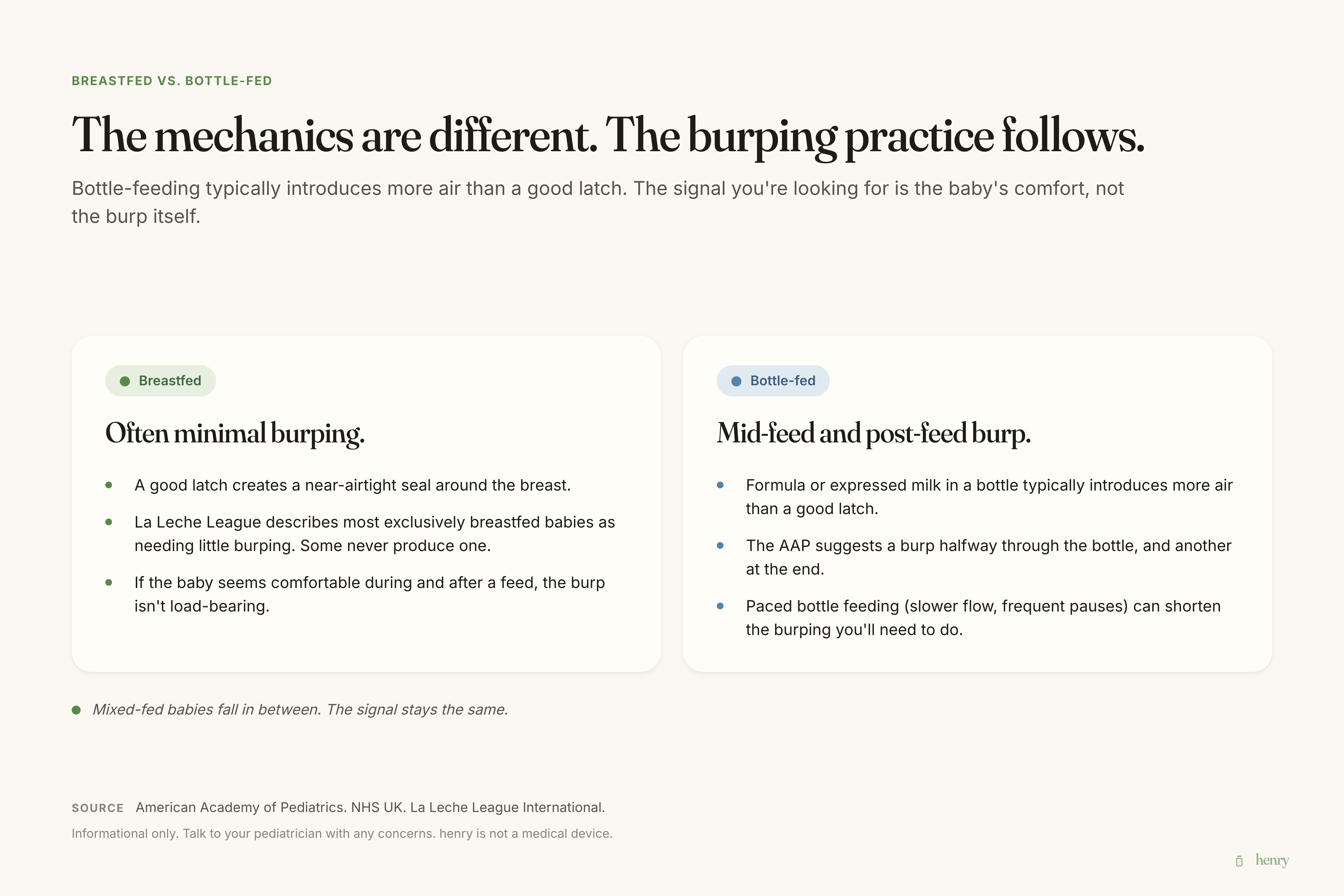
Breastfed. A good latch creates a near-airtight seal around the breast. La Leche League describes most exclusively breastfed babies as needing minimal burping. Some never produce one. The signal is whether the baby seems uncomfortable during or after a feed. If they don't, the burp isn't load-bearing.
Bottle-fed. Bottle feeding (formula or expressed milk) typically introduces more air. The AAP suggests a burp halfway through the bottle and another at the end. Paced bottle feeding (slower flow, frequent pauses) reduces the amount of air swallowed and can shorten the burping you'll need to do.
Mixed-fed babies fall in between. The signal stays the same.
How to burp
Three positions, all approved by the AAP and NHS. Try one, then another if it doesn't work.
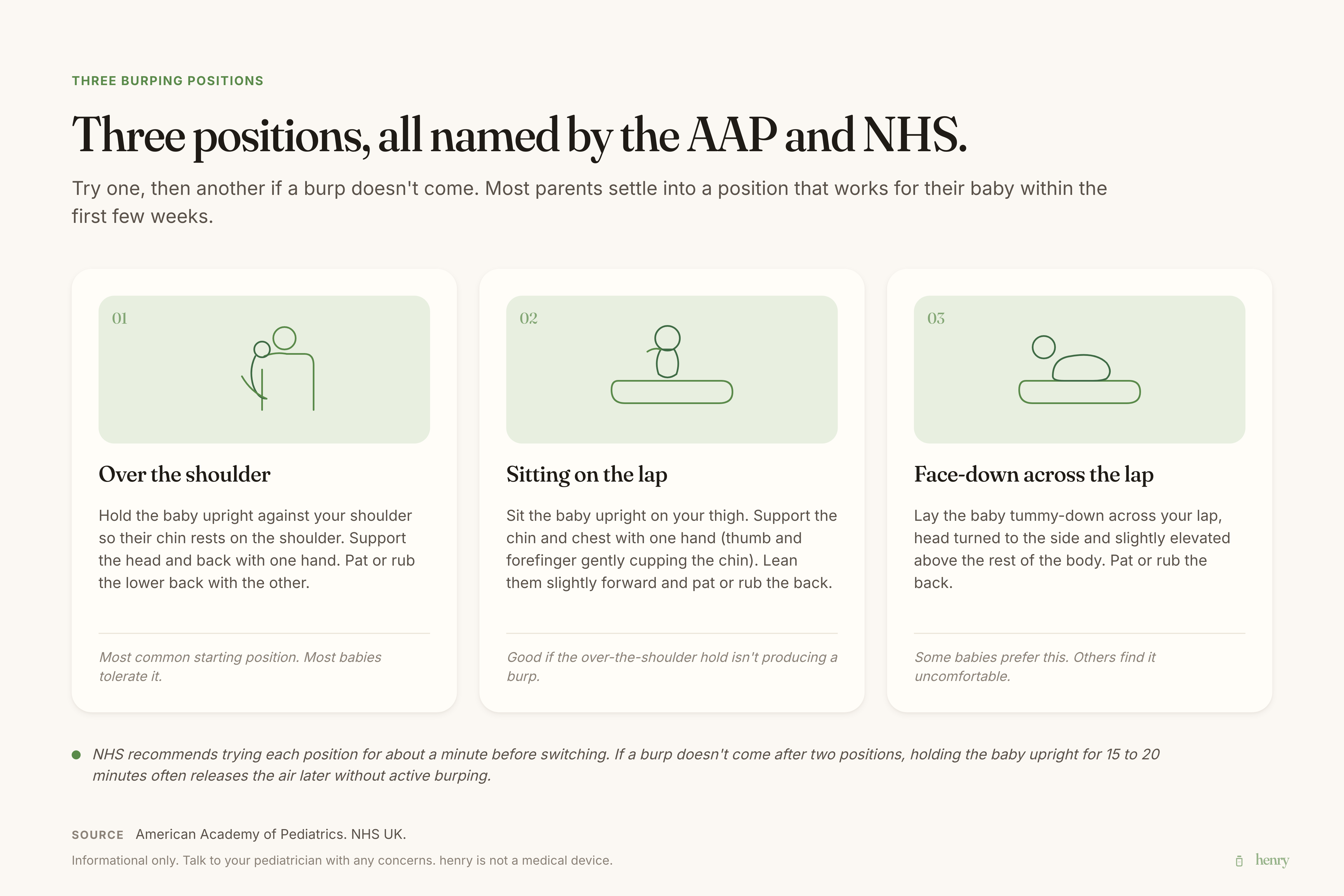
- Over the shoulder. Hold the baby upright against your shoulder so their chin rests on the shoulder. Support the head and back with one hand. Pat or rub the lower back with the other. Most common position; most babies tolerate it.
- Sitting on the lap. Sit the baby upright on your thigh. Support the chin and chest with one hand (thumb and forefinger gently cupping the chin, palm against the chest). Lean them slightly forward. Pat or rub the back with the other hand.
- Face-down across the lap. Lay the baby tummy-down across your lap, head turned to the side and slightly elevated above the rest of the body. Pat or rub the back. Some babies prefer this position; some find it uncomfortable.
The NHS recommends trying each for about a minute before switching. The AAP doesn't put a time on it. Most parents settle into a position that works for their baby within the first few weeks.
If a burp doesn't come after a few minutes of patting in two positions, it's usually safe to stop. A baby who doesn't burp and seems comfortable is fine. A baby who doesn't burp and seems uncomfortable can be helped by holding them upright for 15 to 20 minutes after the feed, which often releases the air later without active burping.
Burp vs. spit-up vs. vomit
These three things look similar to a tired parent and mean different things.
- A burp is air leaving the stomach. It may be silent, it may be loud. Sometimes a small amount of milk comes up with it (called "wet burp" or "possetting"). Within range.
- Spit-up is a larger amount of milk coming back up, usually within 30 minutes of a feed, typically without distress. Mostly cosmetic. The AAP estimates around half of all babies under 3 months spit up at least once a day.
- Vomit is forceful, larger volume, and usually distresses the baby. May happen well after a feed. Not within the range of normal "wet burps."
If your baby is gaining weight, producing wet diapers in the typical range, and is calm between feeds, the spit-up volume is rarely the issue. See How many wet and dirty diapers should a newborn have? for the wet-diaper signals.
After 4 to 6 months
Burping tapers as babies grow. The AAP notes that most babies no longer need burping after about 4 to 6 months because their digestive systems mature and they swallow less air. Solids starting around 6 months further reduces burping needs because solids don't introduce air the way liquid feeds do.
If your baby still wants a post-feed burp at 9 months, that's also fine. The transition is gradual, not a calendar event.
When to call your pediatrician
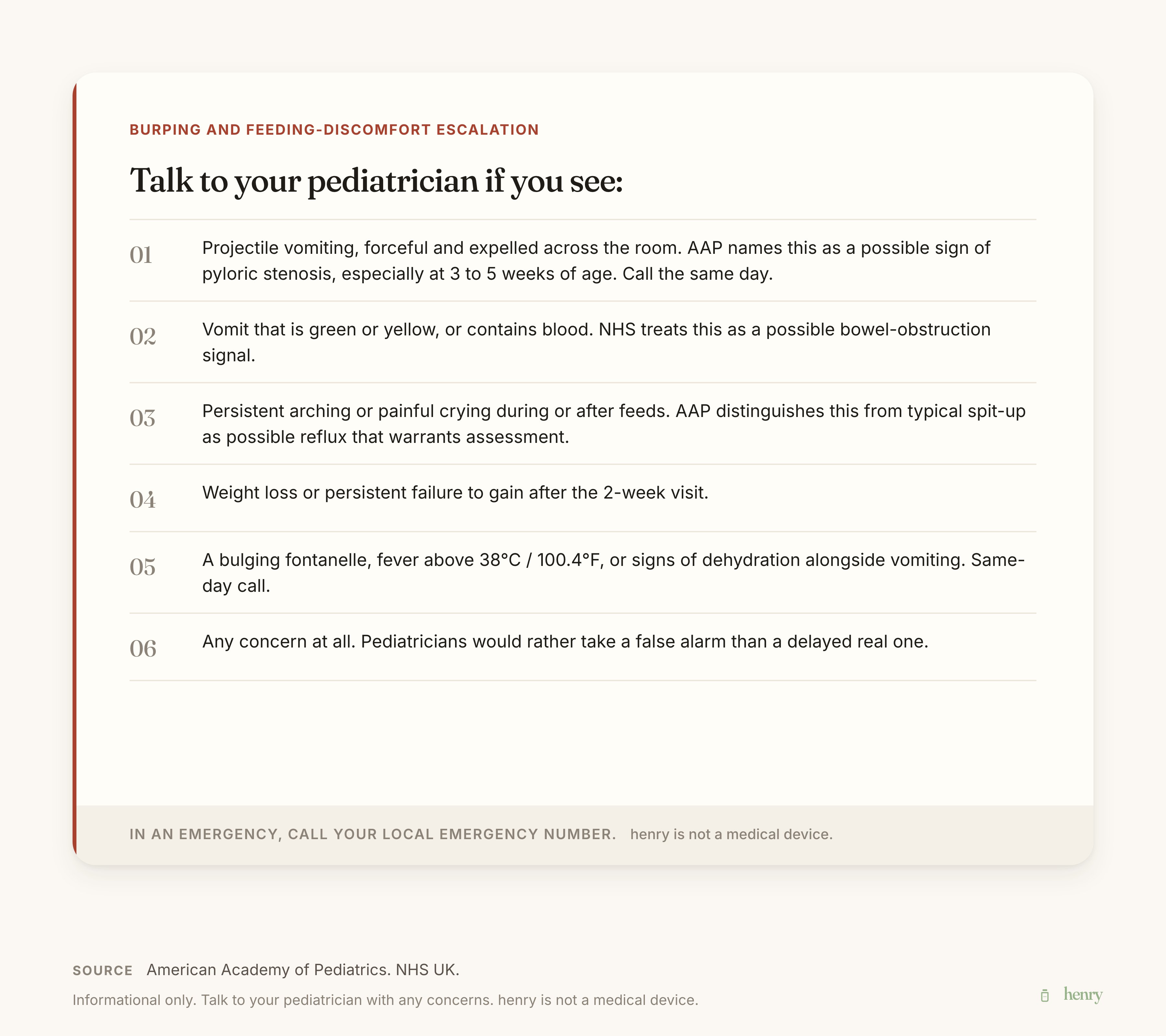
Most burping experiences are routine. Some patterns are not.
- Projectile vomiting. Forceful, expelled across the room. Different from spit-up. The AAP describes it as a possible sign of pyloric stenosis, especially in babies 3 to 5 weeks old. Call the same day.
- Vomit that is green or yellow, or contains blood. Always a call. The NHS treats green or yellow vomit as a possible bowel-obstruction signal.
- Persistent arching, painful crying during or after feeds. Possible reflux that warrants assessment. The AAP distinguishes typical spit-up (no distress) from gastroesophageal reflux disease (with distress) and recommends a pediatrician visit for the latter.
- Weight loss or persistent failure to gain after the 2-week visit. Call. See Newborn weight loss after birth: what's normal? for the typical regain curve.
- A bulging fontanelle, fever above 38°C / 100.4°F, or signs of dehydration alongside vomiting. Same-day call.
- Any concern at all. Pediatricians expect calls from new parents. They would much rather take a false alarm than a delayed real one.
In an emergency, call your local emergency number.
How henry helps
henry logs each feed with its volume, timestamp, and an optional note. The note field is where most parents capture burp info ("no burp", "small burp", "big burp + spit-up") the same way they would in a notebook. When you scroll back through the Today view, the notes show alongside the feed so a 2am pattern (the baby who fusses after every bottle without a mid-feed burp, say) becomes visible across a week. When your pediatrician asks "any pattern with the spit-up?" at the next visit, you'll have the timestamps.
henry is free on the App Store: henrytheapp.com.
henry shows you ranges from the American Academy of Pediatrics, the World Health Organization, the NHS, and La Leche League with their sources cited. We never tell you a number is "good" or "bad," only whether it falls inside or outside what's typical for a baby of that age. If you have any concern about your baby's feeding, growth, diapers, comfort, or health, talk to your pediatrician. In an emergency, call your local emergency number. henry is not a medical device and does not provide medical advice, a diagnosis, or a treatment plan.