By henry · June 5, 2026
Newborn gas and fussiness: what's normal?
The short answer: every newborn is gassy, and every newborn cries more than you expect. Both peak around 6 weeks and ease by 3 to 4 months (AAP). The hard part is that gas and fussiness look connected, so it feels like fixing the gas should stop the crying. Usually it does not. The gas is real, and the crying is real, and most of the time neither one means something is wrong.
henry is a tracking tool, not a diagnostic device. The ranges in this article come from publicly available pediatric guidelines (AAP, NHS). Every baby is different. Always talk to your pediatrician with any concerns about your baby's feeding, output, comfort, or crying.
6pm, legs pulled up
It is 6pm. The baby fed an hour ago and seemed fine. Now they are red-faced, pulling their knees to their chest, grunting, arching, and crying in a way that sounds like pain. You burp them. Nothing. You bicycle their legs. A loud toot, a moment of relief, then back to it. You check the clock and realize this is the third evening in a row at exactly this time.
This has a few names: the witching hour, the fussy evening, the dinner-hour meltdown. It is one of the most common things newborns do, and it peaks right around the age everything else feels hardest.
Gas is normal, and usually not the villain
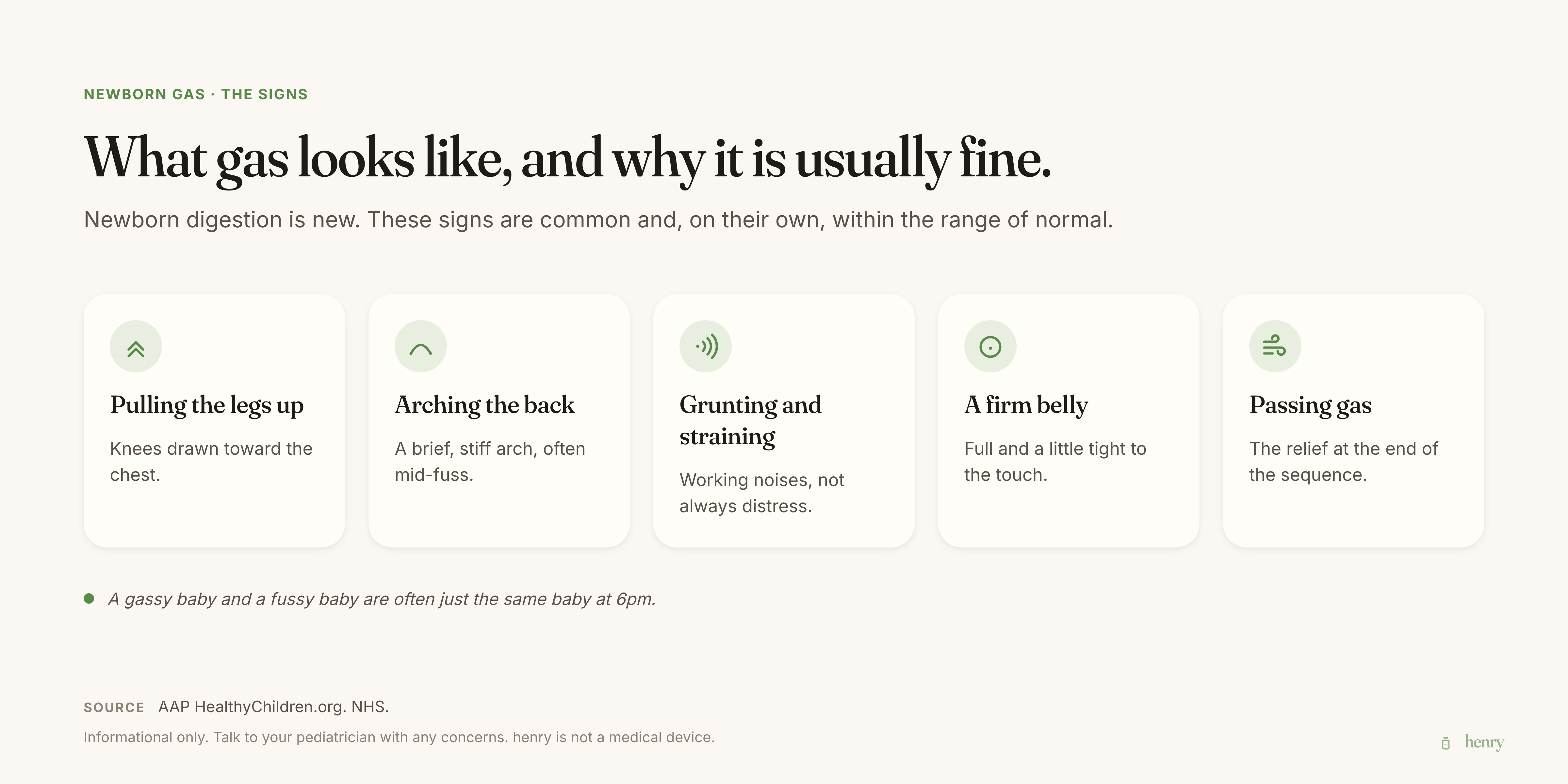
Newborns are gassy because their digestive systems are new. They swallow air when they feed and when they cry, and their gut is still learning to move things along. The AAP and NHS both describe gas as a normal part of early digestion, not a condition to fix.
The signs are familiar: pulling the legs up, arching the back, grunting and straining, a firm belly, and passing gas. On their own, these are within the range of normal. A baby can look like every toot is agony and still be completely fine. Gas gets the blame for evening fussiness because the timing lines up, but a gassy baby and a fussy baby are often just the same baby at 6pm.
Swallowed air is the part you can influence. A good latch, paced bottle feeding, and burping during and after a feed all reduce how much air goes in. See Burping a newborn: what's normal? for the positions and the timing.
The crying curve
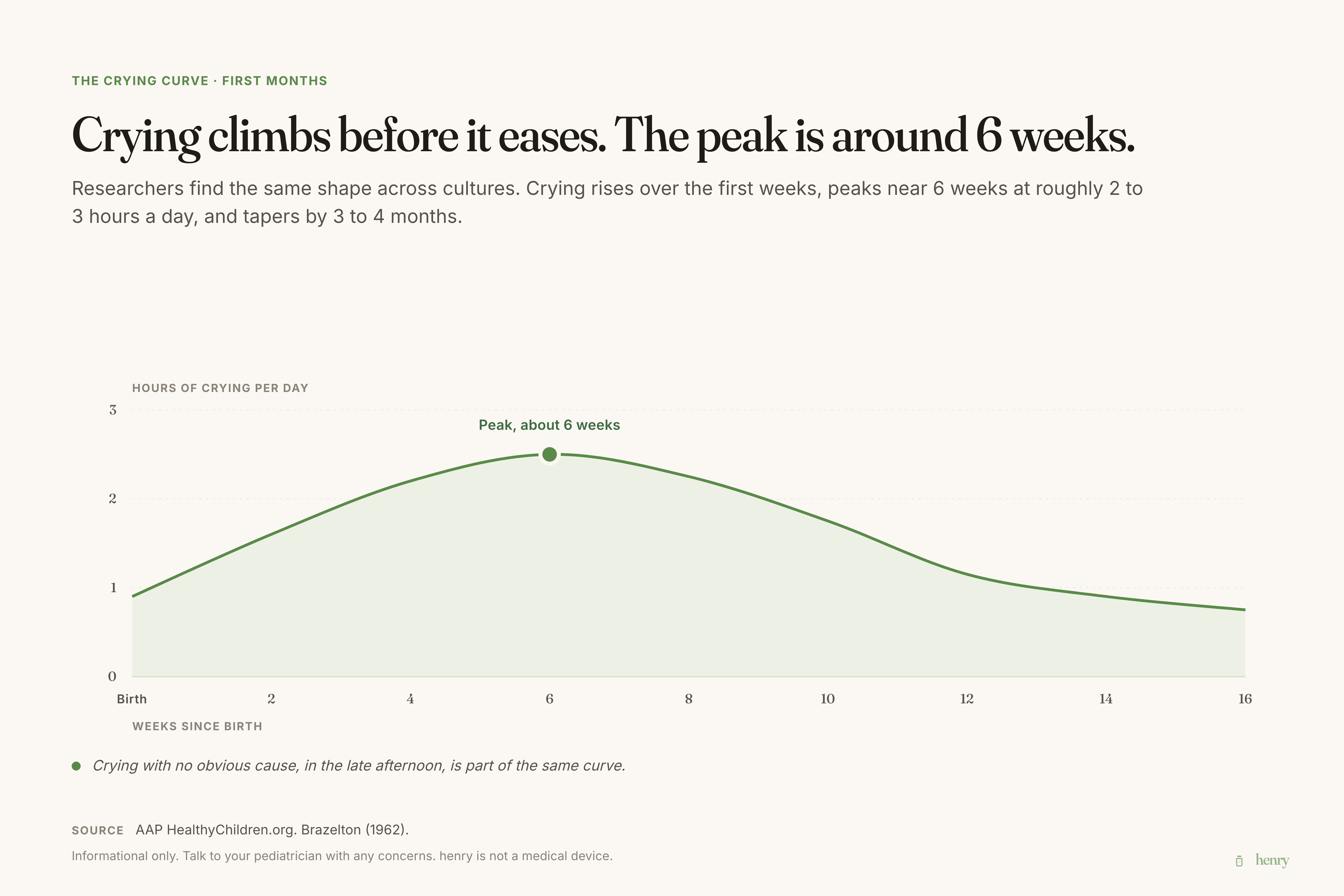
Here is the part no one warns you about: newborn crying is supposed to increase before it gets better. Researchers have mapped the same curve across cultures. Crying climbs over the first weeks, peaks around 6 weeks at roughly 2 to 3 hours a day for many babies, and then tapers down by 3 to 4 months (AAP).
The evening clustering is part of the same pattern. So is crying that has no obvious cause, comes in the late afternoon, and does not respond to the usual fixes. None of that means you are missing something. It means your baby is 6 weeks old.
If the fussiness clusters with short, frequent evening feeds, some of it may be cluster feeding rather than pain. See Cluster feeding: what's normal?.
When fussiness has a name: colic
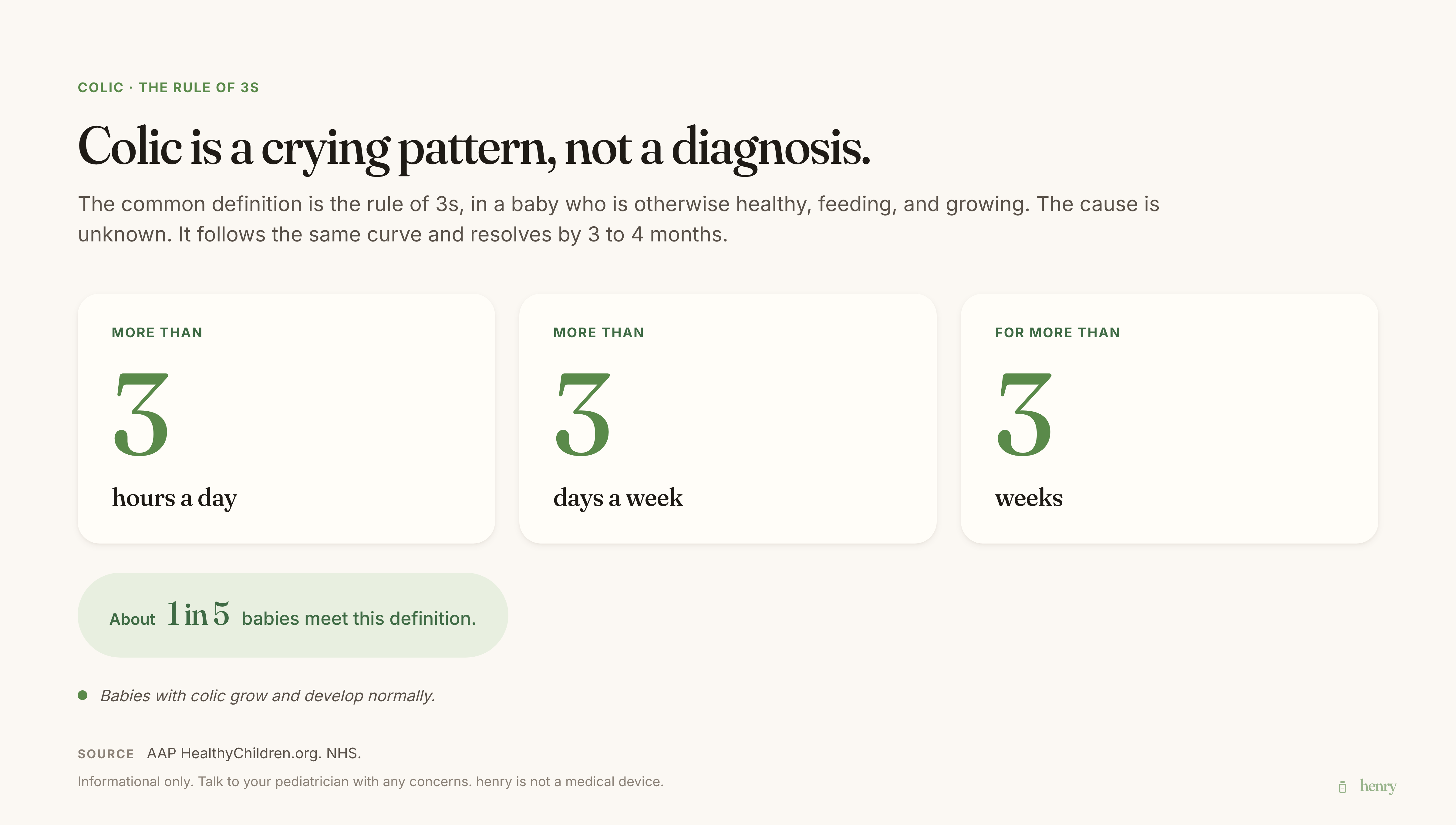
Colic sounds like a diagnosis. It is really just a description of a crying pattern. The common definition is the rule of 3s: crying for more than 3 hours a day, more than 3 days a week, for more than 3 weeks, in a baby who is otherwise healthy, feeding, and growing (AAP, NHS).
A few things worth knowing about colic:
- It is common. Around 1 in 5 babies meet the colic definition (AAP). You are not doing anything wrong.
- The cause is unknown. Despite the name, colic has never been pinned to a single gut problem. It is not a sign that your baby is broken or that your milk is wrong.
- It follows the same curve. Colic typically starts around 2 to 3 weeks, peaks around 6 weeks, and resolves by 3 to 4 months (NHS). Babies with colic grow and develop normally.
Colic is a label for a hard stretch of time, not a problem to be cured. Naming it does not change the baby, but it can change how it feels to get through it.
What actually helps
There is no switch. There are things that take the edge off, and the AAP and NHS describe the same short list: motion and holding, white noise, a pacifier, a warm bath, bicycling the legs, gentle tummy massage, and tummy time while the baby is awake and watched. Reducing swallowed air with burping and paced feeding helps at the margin.
What about gas drops and gripe water? The AAP notes that simethicone (the active ingredient in most gas drops) is generally considered safe but has not been shown to work better than a placebo. Gripe water is not regulated and is not recommended. Probiotics have mixed evidence. None of these is something to start without talking to your pediatrician first.
The most important thing on the list is the least obvious: it is okay to put the baby down and step away. If you are overwhelmed, lay your baby on their back in a safe crib or bassinet, close the door, and take a few minutes in another room. A baby crying alone in a safe space for ten minutes is safe. A baby who is shaken is not. The AAP is direct about this: never shake a baby, ever. If you are at the end of your rope, that is the moment to set the baby down, not to keep going.
When to call your pediatrician
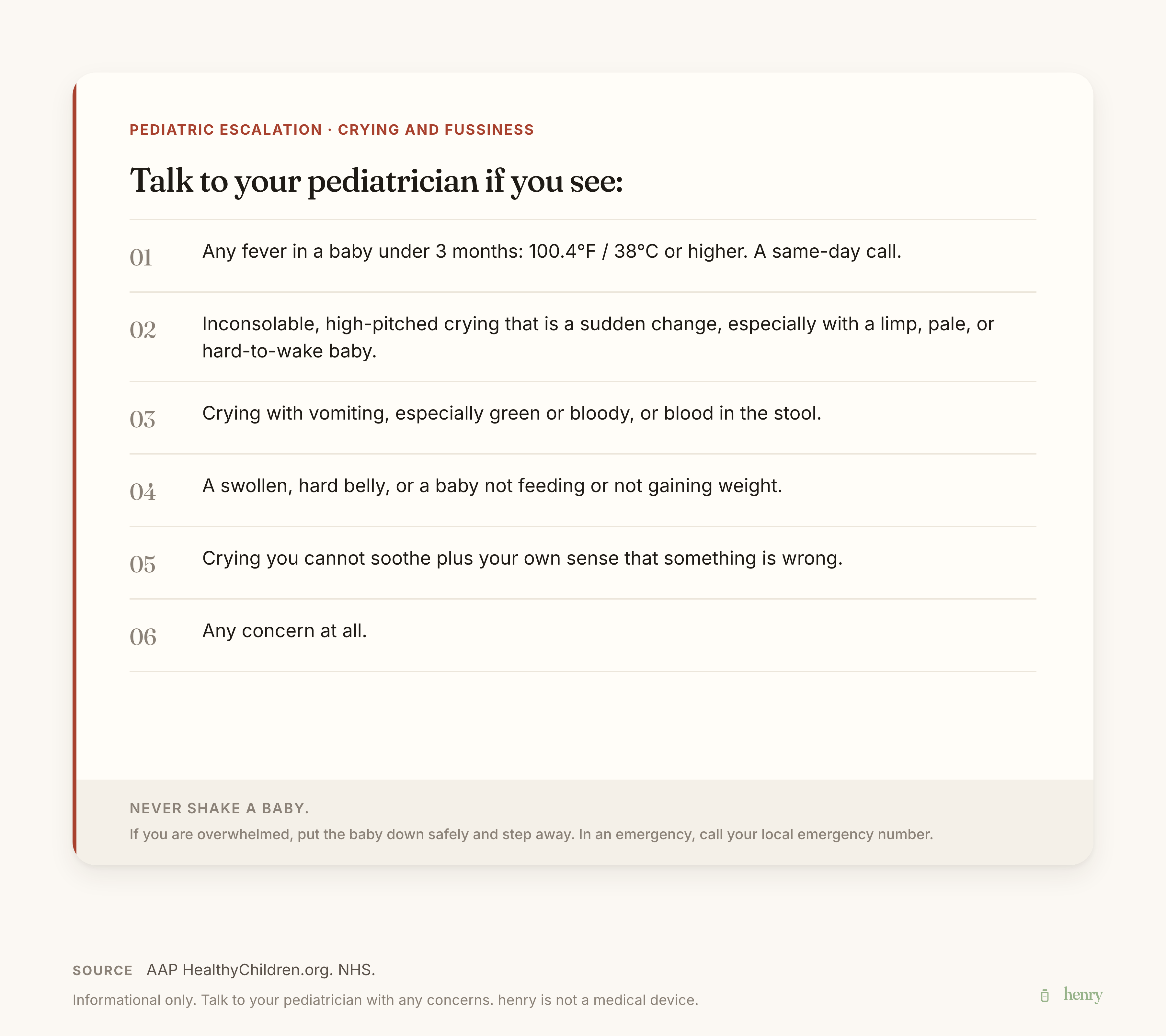
Most fussiness is just fussiness. A few patterns are different, and the difference is usually that the baby seems unwell, not just unhappy.
- Any fever in a baby under 3 months. A temperature of 100.4°F / 38°C or higher is a same-day call, crying or not (AAP).
- Inconsolable, high-pitched crying that is a sudden change from the usual. Especially if the baby also seems limp, very pale, or hard to wake. The NHS treats a sudden change in cry plus an unwell-looking baby as a reason to be seen.
- Crying with vomiting, especially green or bloody vomit, or blood in the stool. Inconsolable crying that comes in waves alongside these can be a sign of a gut problem that needs same-day assessment.
- A swollen, hard belly, or a baby who is not feeding or not gaining weight.
- Crying you cannot soothe combined with your own sense that something is wrong. You know your baby. Trust it and call.
- Any concern at all. Pediatricians expect these calls.
In an emergency, call your local emergency number.
How henry helps
henry does not have a cry timer, and it will not tell you why your baby is fussy. What it does is log the feeds, the notes, and the diapers around the fussiness, which is where the pattern usually hides.
The note field is the useful part. Most parents jot the same shorthand they would in a notebook: "gassy, no burp, fussy 6 to 8pm" or "arched and cried after the evening bottle." Log it on the feed, and when you scroll back through the week the evening cluster shows up plainly. When your pediatrician asks "when is the crying, and what is around it?" you will have the timestamps instead of a guess. And the diaper log is right there for the output side of the question.
henry is free on the App Store: henrytheapp.com.
henry shows you ranges from the American Academy of Pediatrics and the NHS with their sources cited. We never tell you a number is "good" or "bad," only whether it falls inside or outside what's typical for a baby of that age. If you have any concern about your baby's feeding, growth, diapers, comfort, or crying, talk to your pediatrician. In an emergency, call your local emergency number. henry is not a medical device and does not provide medical advice, a diagnosis, or a treatment plan.