By henry · May 29, 2026
Pumping schedules: what's normal?
The short answer: it depends on what you're trying to do. Building supply in the first weeks, replacing daytime feeds when you go back to work, and exclusively pumping each look different on a clock. La Leche League and the AAP describe the same framework. Most pumping parents land somewhere between 6 and 10 sessions per 24 hours in the first months, with the number tapering as the baby grows and supply settles.
henry is a tracking tool, not a diagnostic device. The ranges in this article come from publicly available guidelines (AAP, La Leche League International, Academy of Breastfeeding Medicine, CDC). Every parent's body is different. Always talk to your pediatrician or a lactation consultant with any concerns about your supply, pain, or pumping routine.
The Sunday before back at work
It's Sunday afternoon. You've counted the bags in the freezer twice. You're trying to map next week: 7am pump, the morning daycare drop-off, the conference room at 10am with the door that doesn't quite lock, lunch pump, mid-afternoon pump, the commute home with the cooler bag, evening feed, one more pump after the baby is asleep. You have a spreadsheet open. Then the baby starts crying and you close the laptop.
You're not alone, and you're not doing it wrong. Pumping schedules are puzzles. The same number of pumps fits differently into different days, and what's "enough" depends on the baby, your supply, and what you're trying to do (replace a feed, build a stash, or maintain).
What there is, though, is a pattern.
The first weeks
The early weeks are about supply, not stash. La Leche League and the AAP both note that frequent removal of milk in the first 6 to 8 weeks is what tells the body how much to produce.
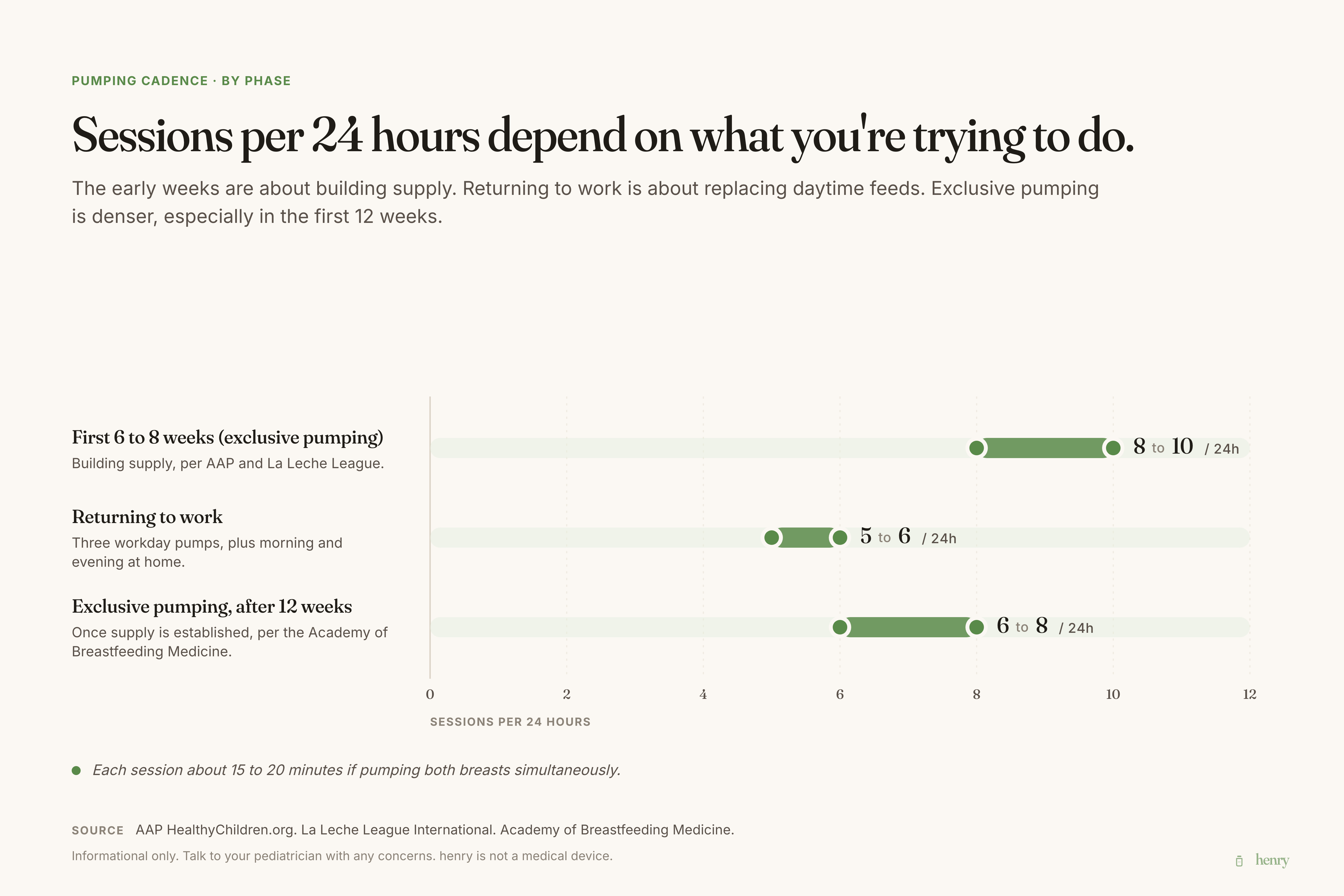
The bookkeeping for the first 6 to 8 weeks:
- 8 to 10 pumping sessions per 24 hours if you are exclusively pumping.
- 1 to 2 pumping sessions per day in addition to nursing, if you're building a small early stash.
- Each session about 15 to 20 minutes, or 2 to 5 minutes past the last drop.
- Spaced roughly every 2 to 3 hours during the day, with a longer overnight gap that varies by parent.
The exact times matter less than the count over 24 hours. A 2am pump skipped this week tends to show up as a supply dip the next.
Returning to work
The most common schedule shift. Most pumping parents at work fit 3 sessions into the workday: morning, lunch, and mid-afternoon. Combined with a morning nursing or pumping session at home and an evening session after the kids are asleep, that lands at 5 to 6 sessions per 24 hours.
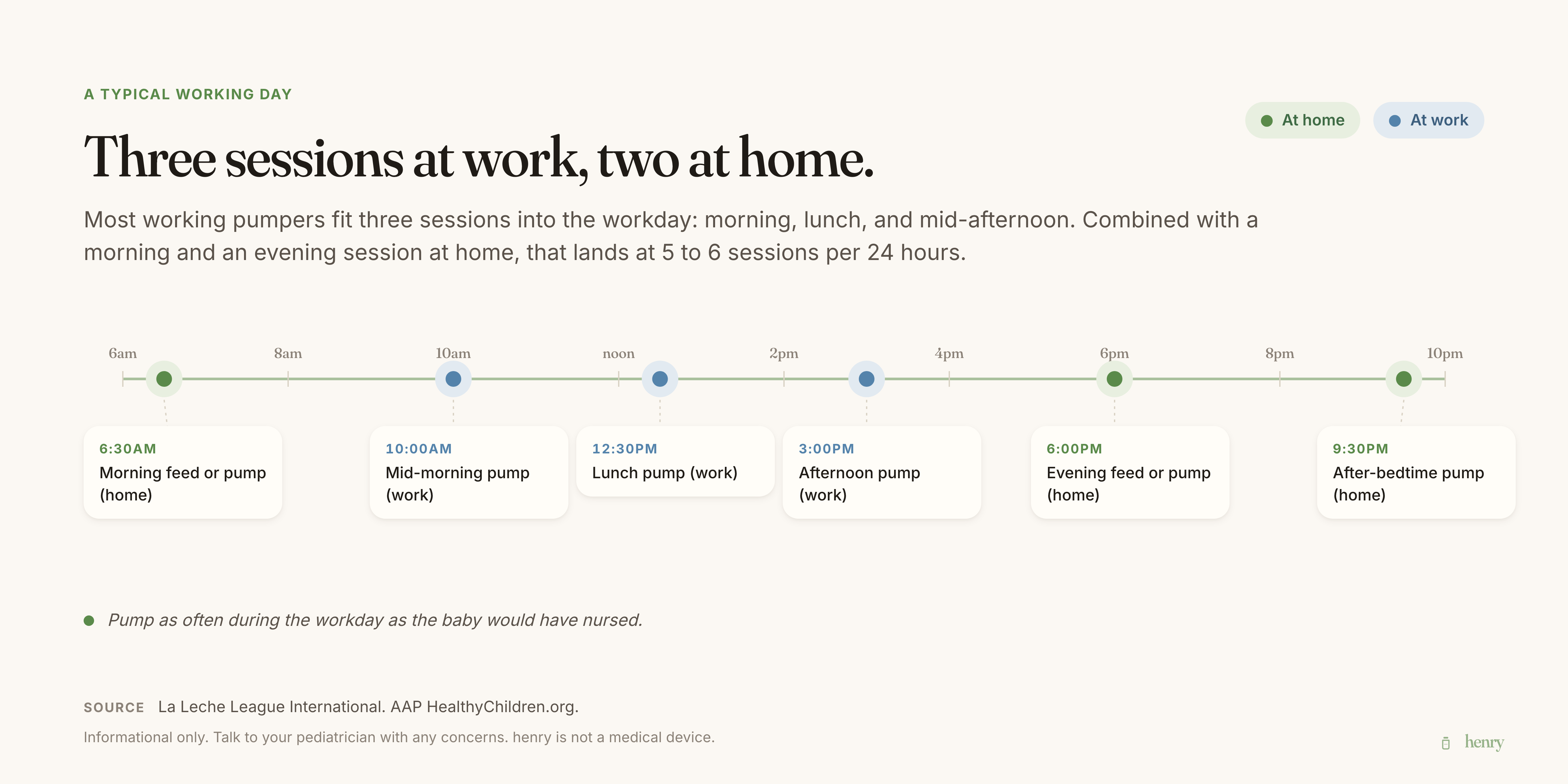
La Leche League's guidance for the working pumper:
- Pump as often during the workday as the baby would have nursed.
- Each session 15 to 20 minutes if pumping both breasts simultaneously.
- Plan an extra session into the freezer-stash-building weeks before your first day back.
The math: a baby who eats 5 times across an 8-hour workday needs roughly that many feeds replaced. Most parents pump 3 to 4 times at work and offset with nursing in the morning and evening.
Output per session is the most-Googled question and the least useful single number. Mornings are typically higher. Stress, sleep, and hydration all show up in the bottle. The AAP and La Leche League both stress that pumping output is not the same as what a baby gets directly from the breast. A baby is more efficient than a pump. A 90 ml output does not mean the breast only had 90 ml.
For a sense of the total daily volume the bottles need to add up to, the AAP range from How much milk should a newborn eat? applies here too.
Exclusive pumping
Exclusive pumping (EP) replaces every feed with a bottle of expressed milk. The schedule is denser, especially in the first 12 weeks.
- 8 to 12 pumping sessions per 24 hours in the first 12 weeks, per the Academy of Breastfeeding Medicine.
- 6 to 8 sessions per day after 12 weeks, once supply is established.
- 4 to 6 sessions per day by 6 months, if supply allows.
The hardest part of EP is the night sessions. La Leche League notes that most EP parents need at least one overnight pump (between midnight and 5am) until 12 to 16 weeks to maintain supply. Dropping a night session before then often causes a supply dip that takes weeks to recover.
Storage rules
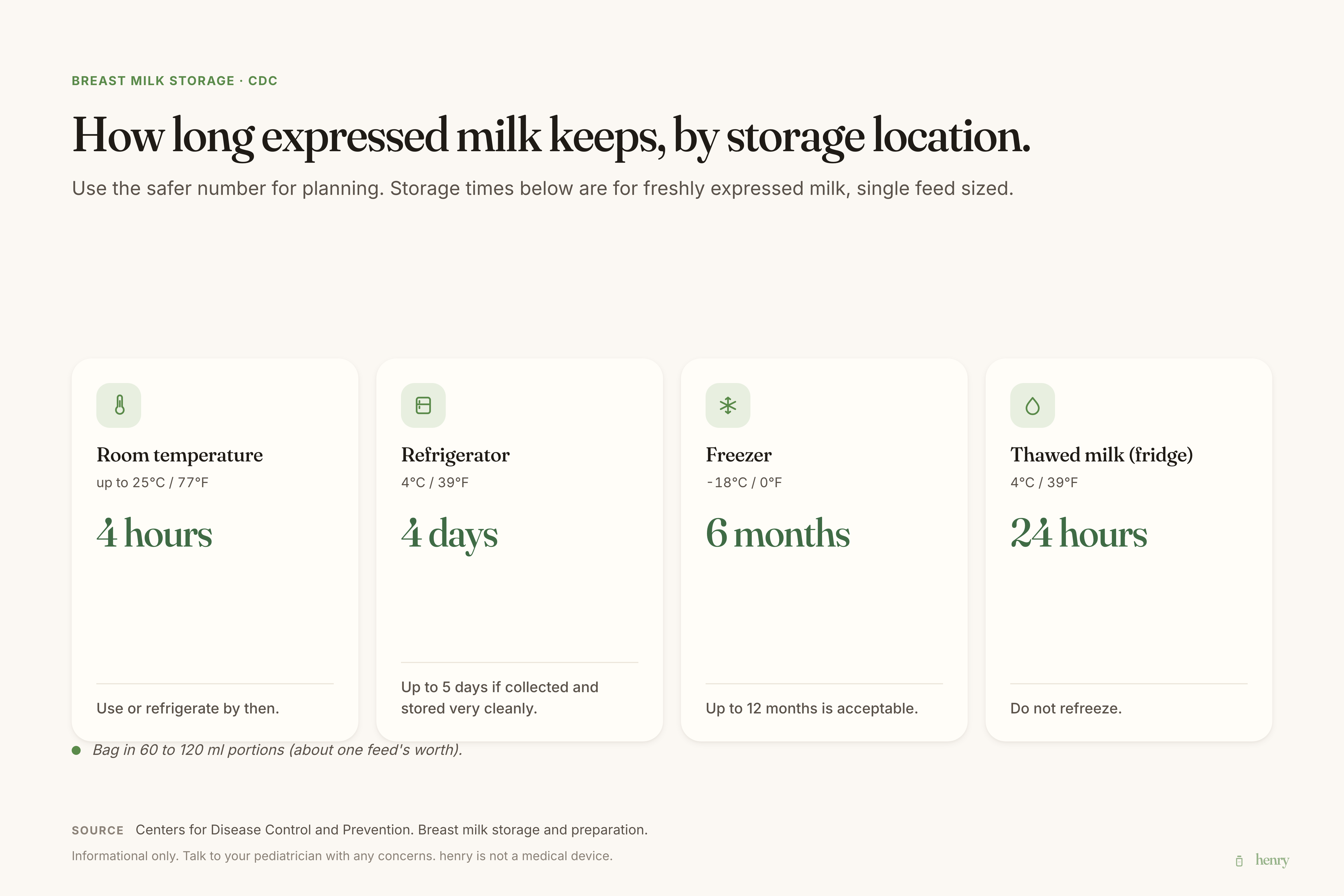
The CDC's storage guidelines for freshly expressed milk are the closest thing to a hard answer in this whole topic.
- Room temperature (up to 25°C / 77°F): use within 4 hours.
- Refrigerator (4°C / 39°F): use within 4 days. The CDC notes that up to 5 days is acceptable if the milk was collected and stored very cleanly; 4 days is the safer planning number.
- Freezer (-18°C / 0°F): 6 months is ideal, up to 12 months is acceptable.
- Thawed milk: use within 24 hours in the fridge. Do not refreeze.
Bag in 60 to 120 ml portions (about one feed's worth). Larger portions waste milk when the baby doesn't finish.
When to call your pediatrician or a lactation consultant
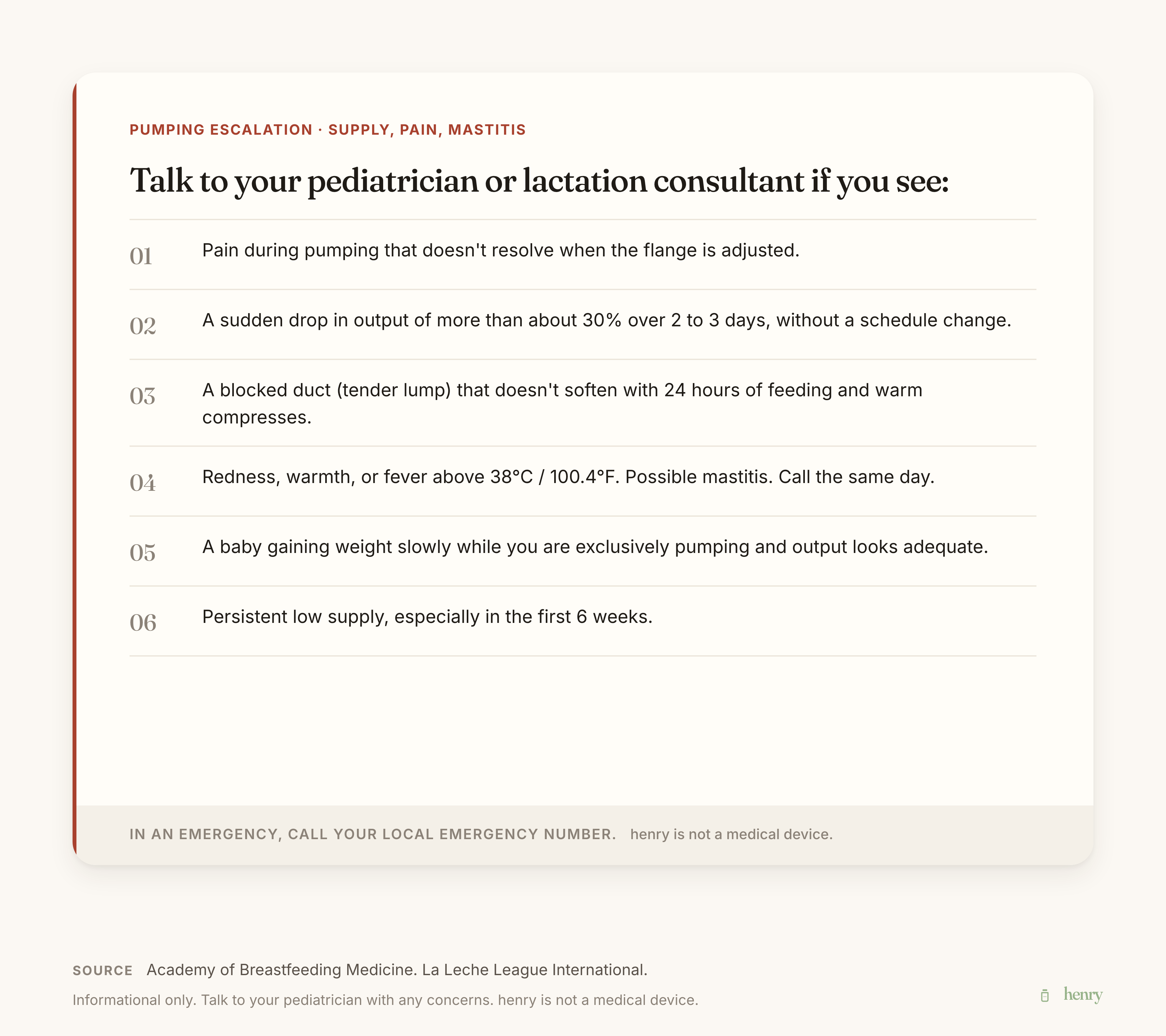
Pumping has its own set of escalation signals. Some of these are urgent.
- Pain during pumping that doesn't resolve when the flange is adjusted. Most common cause is the wrong flange size, and the fix is often immediate.
- A sudden drop in output of more than about 30% over 2 to 3 days, without a schedule change.
- A blocked duct (a tender lump) that doesn't soften with 24 hours of feeding and warm compresses.
- Redness, warmth, or fever above 38°C / 100.4°F. Possible mastitis. Call the same day.
- A baby who is gaining weight slowly while you are exclusively pumping and the output looks adequate. The pediatrician will want to weigh and assess.
- Persistent low supply, especially in the first 6 weeks. A lactation consultant can diagnose latch, transfer, or hormonal causes that a pediatrician will miss.
In an emergency, call your local emergency number.
How henry helps
henry logs each pumping session with the side and the volume in one tap. Trends shows the daily total in ml or oz next to the La Leche League range ("typical range to exclusively feed one baby is ~750 to 900 ml/day"), with the source cited. The Today view shows the gap between sessions at a glance, so when you're standing in the office break room wondering if it's been three hours yet, the answer is on the lock screen.
henry is free on the App Store: henrytheapp.com.
henry shows you ranges from the American Academy of Pediatrics, the World Health Organization, La Leche League, and the CDC with their sources cited. We never tell you a number is "good" or "bad," only whether it falls inside or outside what's typical for a baby or pumping pattern of that age. If you have any concern about your baby's feeding, growth, diapers, or health, or about your supply or pumping comfort, talk to your pediatrician or a lactation consultant. In an emergency, call your local emergency number. henry is not a medical device and does not provide medical advice, a diagnosis, or a treatment plan.