By henry · July 6, 2026
Bathing a newborn: what's normal?
The short answer: far less often than you think. The AAP puts newborn baths at about three a week, and until the umbilical cord stump falls off (usually 1 to 3 weeks), they are sponge baths, not tub baths. More washing than that mostly dries out newborn skin. The parts that matter are not frequency at all: warm-not-hot water, and a hand on the baby every second they are near water.
henry is a tracking tool, not a diagnostic device. The guidance in this article comes from publicly available pediatric sources (AAP, WHO, NHS). Every baby is different. Always talk to your pediatrician with any concerns about your baby's skin, cord, or health.
The first bath has an audience
Nobody is calm at the first bath. The water has been tested four times. The towel is pre-warmed. Two adults are assigned to a person who weighs less than the towel. Someone's mother is watching on a video call, offering commentary. And the baby, unmoved by the preparation, screams from the first drop of water to the last, then falls asleep mid-buttoning.
Two things are true at once: a wet baby is the slipperiest object in your home, and none of this is as precarious as it feels. The routine below is short, and it gets boring fast. Boring is the goal.
How often: less than you think
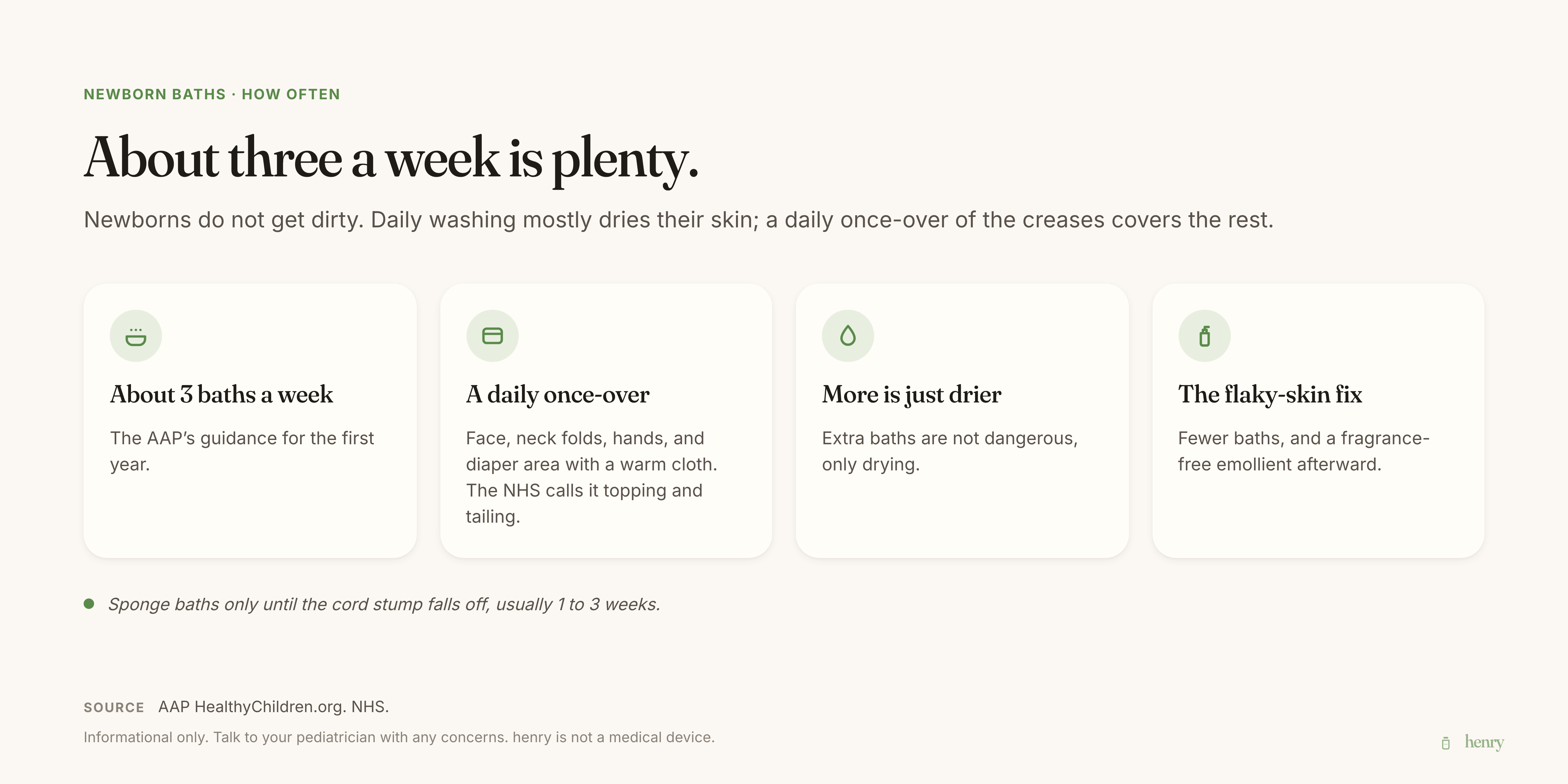
Newborns do not get dirty. They do not crawl, sweat much, or handle doorknobs. The AAP's guidance is a bath about three times a week in the first year; the NHS agrees and adds the useful habit it calls "topping and tailing": a daily once-over of the face, neck folds, hands, and diaper area with a soft cloth and warm water, no tub required.
Bathing more often is not dangerous, just drying. Newborn skin loses moisture fast, and daily soap accelerates it. If the skin looks flaky, fewer baths and a fragrance-free emollient afterward are the usual fix.
Until the cord falls off: sponge baths and dry care
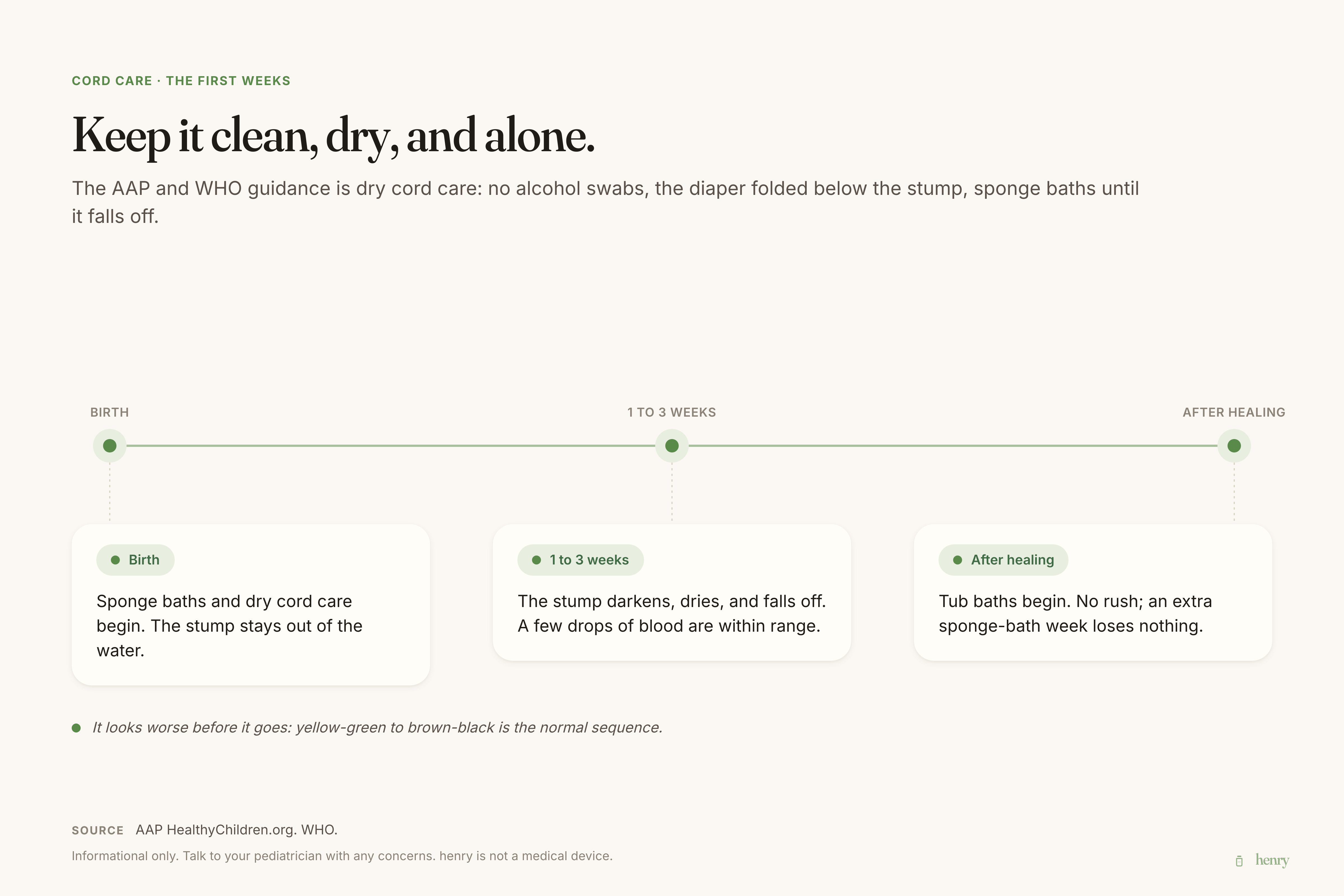
The umbilical cord stump usually dries up and falls off between 1 and 3 weeks. Until then:
- Sponge baths only. A warm room, a towel to lie on, a basin of warm water, and a washcloth. The stump stays out of the water.
- Dry cord care. The AAP and WHO guidance is to keep the stump clean and dry and otherwise leave it alone. The old alcohol-swab routine is no longer recommended; air does the work.
- Fold the diaper below it. Most newborn diapers have a notch for exactly this. A dry stump detaches sooner.
- Expect it to look worse before it goes. The stump darkens from yellow-green to brown-black as it dries. A few drops of blood when it detaches, like a scab coming off, are within range.
Once the stump is gone and the area has healed, tub baths begin. There is no rush; a baby who has sponge baths for an extra week is losing nothing.
The safe bath
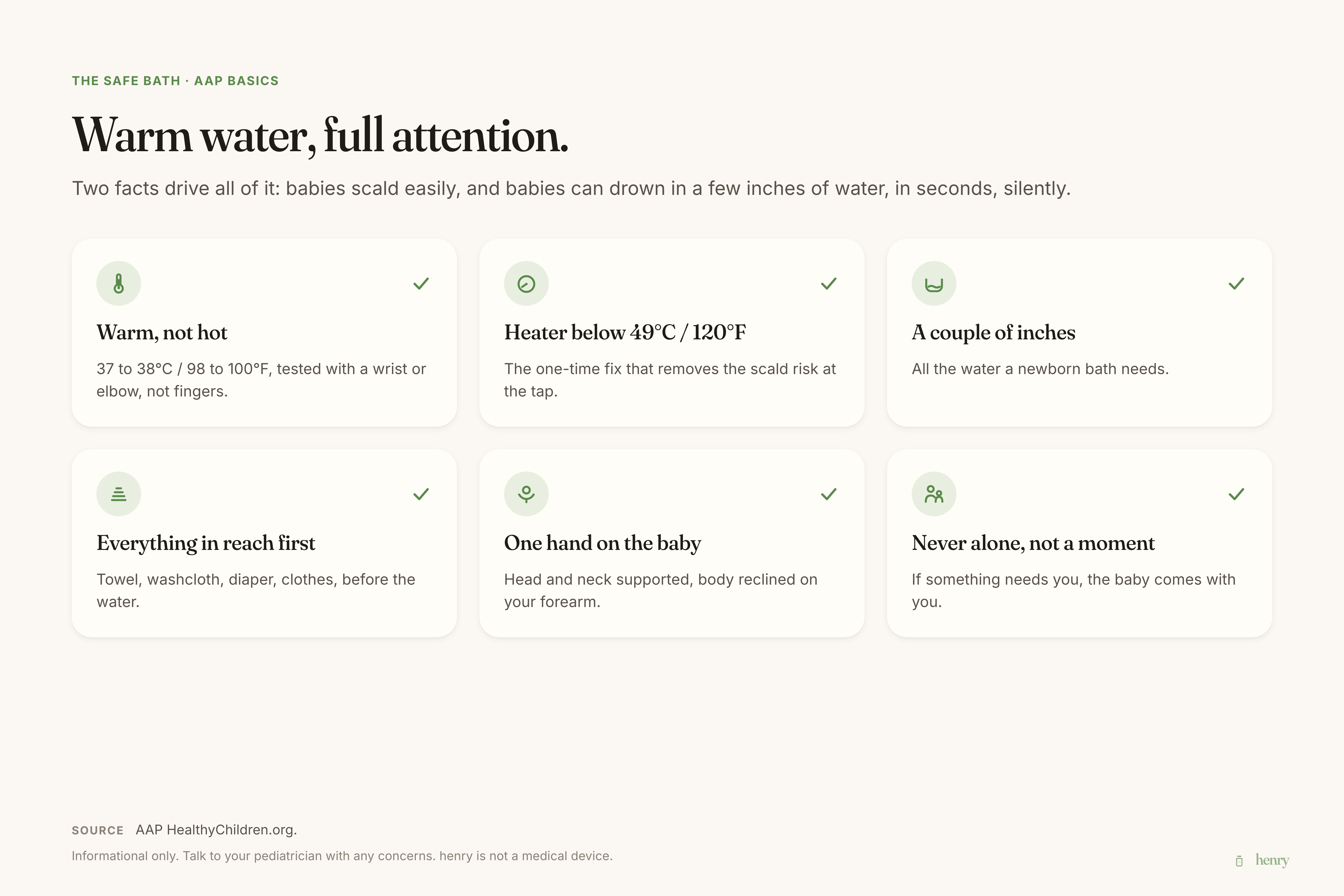
This is the section where the source matters most, and the AAP's guidance is built around two facts: babies scald easily, and babies can drown in a few inches of water, in seconds, silently.
- Warm, not hot. Bath water around body temperature, roughly 37 to 38°C / 98 to 100°F. Test it with your wrist or elbow, not your fingers; they tolerate more heat than a baby's skin.
- Set the water heater below 49°C / 120°F. The one-time fix that removes the scald risk at the tap.
- A couple of inches of water. That is all a newborn bath needs.
- Everything within reach before the baby touches water. Towel, washcloth, clean diaper, clothes. The bath does not start until the pile is complete.
- One hand on the baby, always. Supporting the head and neck, with the body reclined on your forearm. The grip gets confident by the third bath.
- Never alone. Not for the doorbell, not for the phone, not for one moment. If something needs you, the baby comes with you, wrapped in the towel. This is the only rule on the list with no soft version.
The wash itself
Short and top-down. Face first with plain water, no soap. Then the body, paying attention to the folds where milk collects: neck creases, behind the ears, armpits, thigh rolls. A mild, fragrance-free baby wash is fine used sparingly; plain water does most of the job in the early weeks (NHS). Diaper area last. For girls, wipe front to back. For uncircumcised boys, wash what you can see and leave the foreskin alone; it separates on its own timeline (AAP).
Afterward: pat dry rather than rub, get into the creases, and a fragrance-free emollient if the skin runs dry. The whole production, start to finish, is under ten minutes.
Two timing notes. The WHO recommends waiting at least 24 hours after birth for the very first bath, which is why hospitals have mostly stopped bathing newborns in the first hours. And an evening bath makes a fine anchor for a wind-down routine once you want one, though it is entirely optional; the rhythm matters more than the ritual. Newborn sleep: what's normal? covers what that routine is actually working with.
When to call your pediatrician
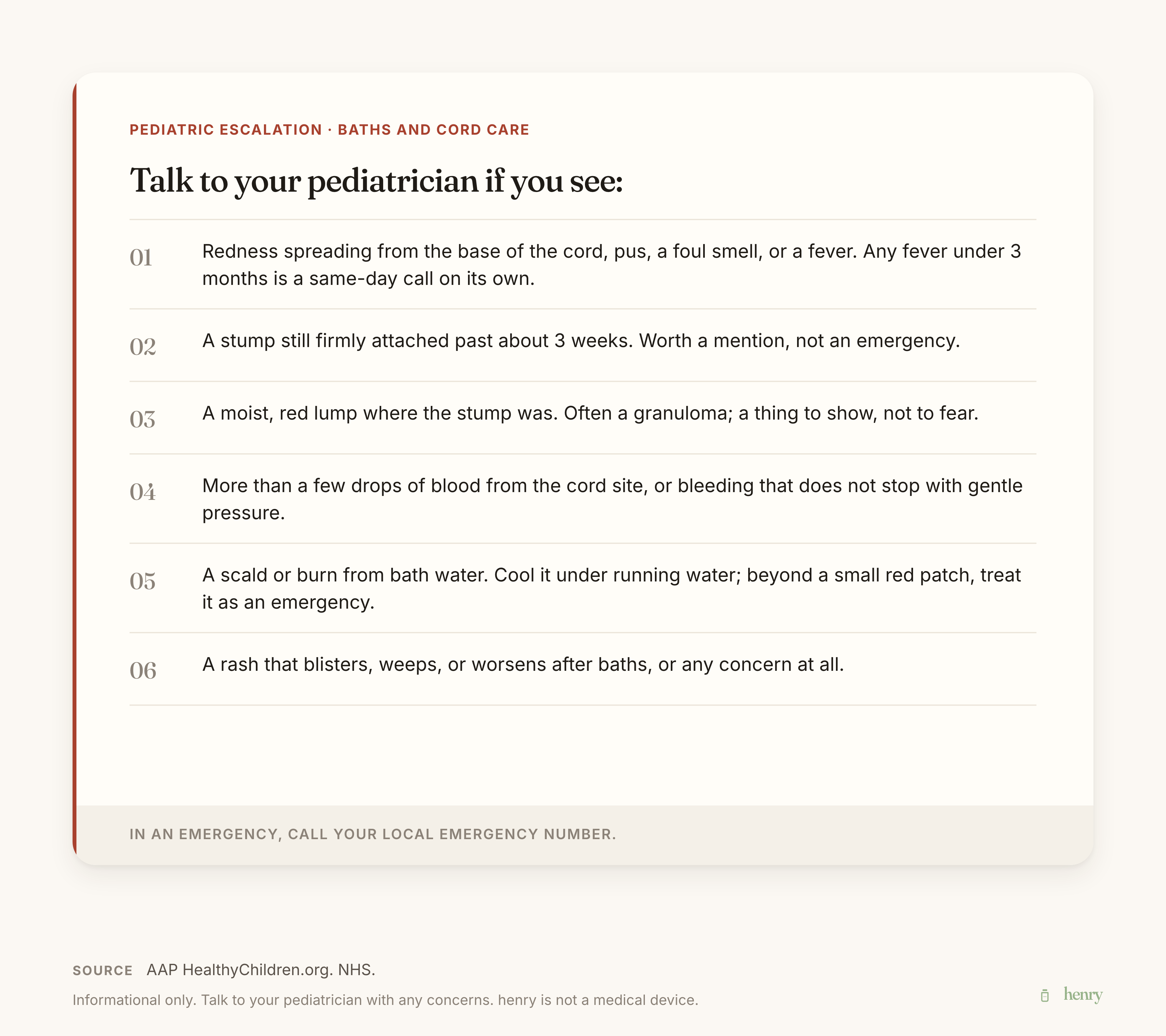
Baths and cord care are low-drama. A few things are not.
- Redness spreading from the base of the cord, pus, a foul smell, or the baby running a fever. These are the signs of a cord-site infection, which needs same-day attention. Any fever in a baby under 3 months is a same-day call on its own (AAP).
- A stump still firmly attached past about 3 weeks. Worth a mention, not an emergency.
- A moist, red lump where the stump used to be. Often an umbilical granuloma, common and treatable; a thing to show, not to fear.
- More than a few drops of blood from the cord site, or bleeding that does not stop with gentle pressure.
- A scald or burn from bath water. Cool the area with running water and call; for anything beyond a small red patch, treat it as an emergency.
- A rash that blisters, weeps, or worsens after baths. Show it at the next visit, sooner if the baby seems unwell.
- Any concern at all. Cord questions are a staple of the first-month checkups.
In an emergency, call your local emergency number.
How henry helps
henry does not track baths, and bath time may be the best argument for that kind of restraint: it is the one newborn task that works better as a ritual than as a data point. Ten minutes, warm water, no numbers.
There is exactly one date worth writing down, and the note field on any log will hold it: the day the cord stump fell off. Your pediatrician will ask about cord healing at the early visits, and "day 12, few drops of blood, healed clean" is a better answer than squinting at the ceiling. Log it once, then go back to ignoring the app during bath time. That is what the other trackers are for.
henry is free on the App Store: henrytheapp.com.
henry shows you ranges from the American Academy of Pediatrics, the World Health Organization, and the NHS with their sources cited. We never tell you a number is "good" or "bad," only whether it falls inside or outside what's typical for a baby of that age. If you have any concern about your baby's skin, cord, feeding, or health, talk to your pediatrician. In an emergency, call your local emergency number. henry is not a medical device and does not provide medical advice, a diagnosis, or a treatment plan.